
There is no established CJC-1295 ipamorelin dosage, because no trial has ever given the two compounds together. Every chart agrees with the next one and none of them agree with the trials. We traced their figures back to a different molecule.
The short answer. No trial has dosed CJC-1295 and ipamorelin together. There is no established dose for the combination, only separate single-compound studies.
- Every human CJC-1295 dose in the literature — 30 to 90 µg/kg — was measured on the DAC form, whose half-life is 5.8 to 8.1 days. Blends use the no-DAC form, which has no published human pharmacokinetics.
- Ipamorelin's only human trial gave 0.03 mg/kg intravenously twice daily for postoperative ileus, and missed its endpoint.
- The animal ipamorelin work is in nmol/kg — 80 nmol/kg in rats, 2.3 nmol/kg in swine — which does not convert to a human milligram figure.
There is no set dose for the pair, because no trial has ever given CJC-1295 and ipamorelin together. On their own, healthy adults got CJC-1295 at 30 to 60 µg/kg in single shots under the skin. A Phase 2 trial gave ipamorelin at 0.03 mg/kg into a vein, twice a day. Both were different products from the blend.
Why does the DAC form change the CJC-1295 dose?
CJC-1295 exists in two forms, and the human literature covers only one of them. The studied form carries a drug affinity complex, a chemical handle that binds circulating albumin and keeps the peptide in the blood for days. Teichman and colleagues measured its half-life at 5.8 to 8.1 days.
The form sold in a co-lyophilized blend is almost always the other one: no DAC, also sold as Modified GRF 1-29. It's a different pharmacokinetic object.
Under that name it has no published human pharmacokinetic study at all. Not a half-life, not a dose-response curve, not a single peer-reviewed administration in people.
This is the error that propagates. Every microgram-per-kilogram figure in the CJC-1295 human record was measured on the albumin-bound form, dosed once and left to work for a week.
Quoting those figures for a no-DAC blend given daily transplants a number across a half-life difference of roughly two orders of magnitude. The chart isn't wrong by a little.
The closest published human protocol for a short-acting GHRH(1-29) analog isn't CJC-1295 at all. Khorram and colleagues gave 10 µg/kg of [Nle27]GHRH-(1-29)-NH2 subcutaneously each night for 16 weeks, to 19 adults aged 55 to 71.
Growth hormone rose within 10 minutes and the release lasted about two hours. That's a related molecule rather than the same one, and we'd say the distinction is the whole point of this section.
What CJC-1295 doses did the trials use?
We found two published CJC-1295 studies, both in healthy adults, both on the DAC form.
| Study | Dose administered | Route and schedule | What it measured |
|---|---|---|---|
| Teichman et al., 2006 | Four ascending single doses; 30 and 60 µg/kg named as best tolerated | Subcutaneous, single or weekly/biweekly | GH up 2– to 10-fold for 6+ days; IGF-I up 1.5– to 3-fold for 9–11 days |
| Ionescu & Frohman, 2006 | 60 or 90 µg/kg | Subcutaneous, one injection | Trough GH up 7.5-fold; mean GH up 46%; IGF-I up 45%, pulsatility preserved |
Subcutaneous administration of CJC-1295 resulted in sustained, dose-dependent increases in GH and IGF-I levels in healthy adults. [It] was safe and relatively well tolerated, particularly at doses of 30 or 60 microg/kg.
Teichman et al., Journal of Clinical Endocrinology and Metabolism, 2006Note what the second study found: 60 and 90 µg/kg produced no significant difference from each other. That's a ceiling showing up in the data at the top of the studied range.
It's the kind of finding a dose-response trial exists to produce, and the kind that never appears on a chart.
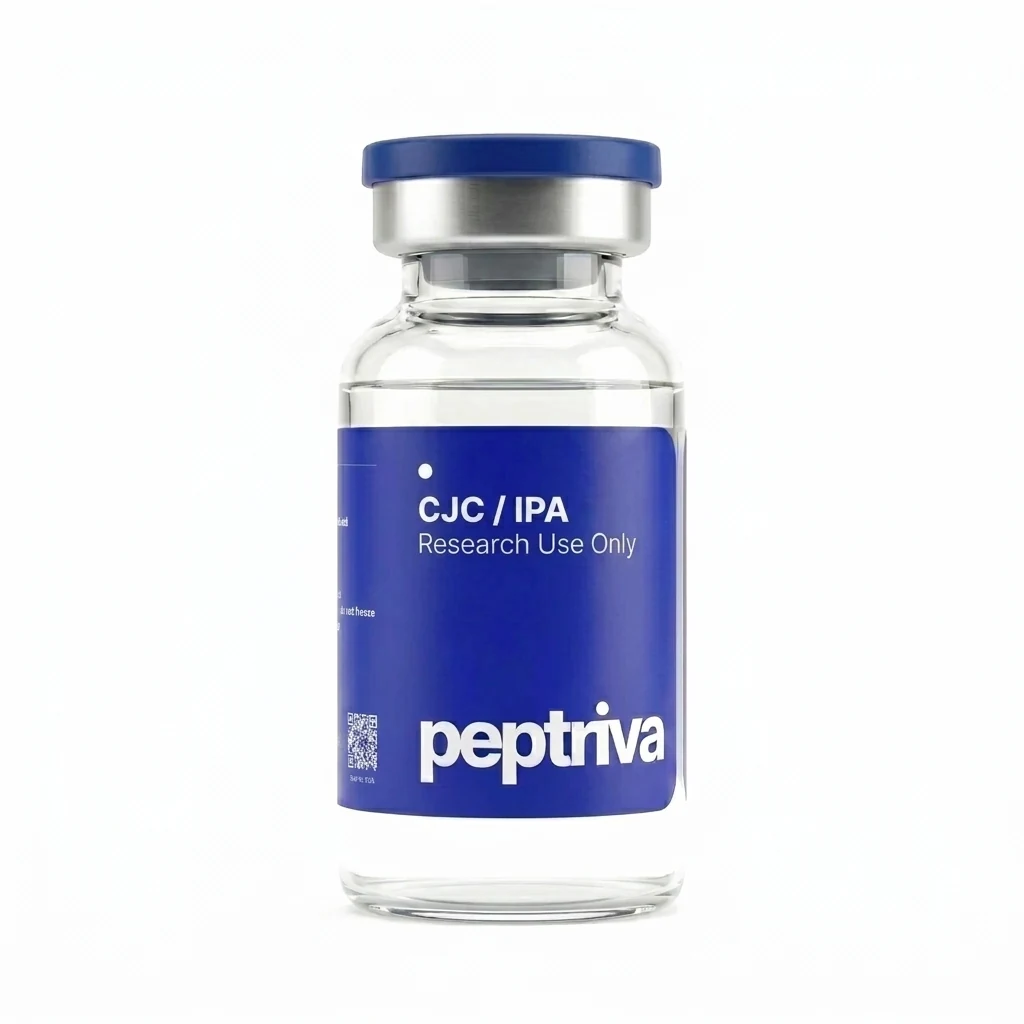
CJC-1295 / Ipamorelin
The co-lyophilized blend discussed here, supplied as a research compound with a certificate of analysis matched to the lot.
What ipamorelin dose has been given to people?
Ipamorelin's entire human record is one trial. Beck and colleagues ran a Phase 2 proof-of-concept study in patients recovering from bowel resection, giving 0.03 mg/kg intravenously twice daily for up to seven days.
Median time to a tolerated meal was 25.3 hours on ipamorelin against 32.6 on placebo, which didn't reach significance.
There were no significant differences between ipamorelin and placebo in the key and secondary efficacy analyses.
Beck et al., International Journal of Colorectal Disease, 2014Everything before that is animal pharmacology. Raun and colleagues, describing the compound in 1998, reported a half-maximal dose of 80 nmol/kg in anesthetized rats and 2.3 nmol/kg in conscious swine. A 2024 study gave ferrets 1 to 3 mg/kg intraperitoneally. Three species, three routes, three unit systems, and no bridge to a person.
There's a correct way to cross that bridge, and it isn't multiplication. The FDA's guidance on first-in-human starting doses converts animal doses by body surface area, dividing a rat dose by 6.2 and a ferret dose by 5.3.
Even then the output is only the opening rung of a Phase 1 safety study, before a further safety factor is applied. It's where a trial starts, not what a trial found, and not a number you can dose from.
Has the CJC-1295 and ipamorelin pair ever been dosed in a trial?
No published trial has dosed the pair. The rationale for pairing them is real pharmacology. A GHRH analog and a ghrelin-receptor agonist act through separate receptors on the same pituitary cells, and the class effect has been described since the 1990s.
The GH-releasing activity of GHRPs is synergistic with that of GHRH…
Ghigo et al., European Journal of Endocrinology, 1997That sentence describes GHRPs as a class, measured as an acute hormone response in single-dose studies. It isn't a protocol, and it says nothing about how much of either compound to give, how often, or for how long. Three things don't exist.
- No randomized trial of the pair. Not for body composition, not for recovery, not for sleep, not for aging endpoints, not for anything.
- No published pharmacokinetics for the two together. Nobody has measured what co-administration does to either compound's exposure.
- No long-term safety data for combined stimulation. The class reviews are explicit that few long-term controlled studies of growth hormone secretagogues exist, with insulin sensitivity the flagged concern.
Ghigo's review also recorded that the GH response to these peptides desensitizes: more during continuous infusion, less during intermittent dosing. A repeated-dosing schedule is exactly the setting where that matters, and exactly the setting no trial has examined for this pair.
What does a 5 mg + 5 mg blend vial imply?
The standard research blend is 5 mg of each, co-lyophilized in one vial. Set the published doses against that and the mismatch is not subtle.
- CJC-1295 at 30–60 µg/kg. For a 70 kg adult that is 2.1 to 4.2 mg in a single injection — most or all of the CJC-1295 in the vial, once, for the form with a week-long half-life.
- Ipamorelin at 0.03 mg/kg twice daily. For the same adult that is about 4.2 mg a day, infused intravenously in hospital. Roughly the vial's whole ipamorelin content per day, by a route nobody outside a ward is using.
- A fixed ratio. Co-lyophilization locks the two together. Any draw delivers both in the ratio the filler chose, so neither can be varied independently — which is the first thing a dose-finding study would need to do.
We'll be clear about what this arithmetic shows. It's not an argument that the trial doses are the right doses. It's evidence that the microgram figures circulating as protocols weren't derived from the trials at all. If they had been, they'd land near these numbers. They don't land anywhere near them.
What is knowable is the material. A blend can hit its stated total mass while being mostly one component, and a per-component purity figure won't catch that. Only a weight-percent breakdown will.
How to read a COA covers what you should look for. The buyer's guide covers the DAC identity check a purity number alone can't make.
CJC-1295 / Ipamorelin
Research-use-only material, sold by the vial with batch documentation. Check the certificate of analysis against the batch you receive.
Both compounds appear on their own rows in our peptide dosage chart, with the trial that produced each figure named beside it.
Both figures are per kilogram, so they need converting before they mean anything as a volume. The peptide calculator does that from the vial strength and the diluent.
What to know now
- No trial has dosed CJC-1295 and ipamorelin together. There is no established dose for the combination, only separate single-compound studies.
- Every human CJC-1295 dose in the literature — 30 to 90 µg/kg — was measured on the DAC form, whose half-life is 5.8 to 8.1 days. Blends use the no-DAC form, which has no published human pharmacokinetics.
- Ipamorelin's only human trial gave 0.03 mg/kg intravenously twice daily for postoperative ileus, and missed its endpoint.
- The animal ipamorelin work is in nmol/kg — 80 nmol/kg in rats, 2.3 nmol/kg in swine — which does not convert to a human milligram figure.
- Co-lyophilization fixes the ratio, so neither component can be varied independently. That is the first thing a dose-finding study would have to do.
What we're watching
We're watching for a published pharmacokinetic study of no-DAC CJC-1295 in people. That means a half-life and an exposure curve for the molecule actually in the vial, not for its albumin-bound cousin. It's the single most useful thing that could happen here.
After that, a registered trial of the pair at any dose, for any endpoint. Neither is on ClinicalTrials.gov as of this revision, and until one is, every schedule in circulation is a reconstruction.
Frequently asked questions
What is the correct CJC-1295 and ipamorelin dose?
There isn't an established one. No published trial has given CJC-1295 and ipamorelin together, so any combined protocol you find was reconstructed rather than measured.
What dose of CJC-1295 was used in human studies?
Teichman et al. (2006) gave four ascending single subcutaneous doses and named 30 and 60 µg/kg as the best tolerated. Ionescu and Frohman (2006) gave single doses of 60 or 90 µg/kg. Both studies used the DAC form, which has a half-life of 5.8 to 8.1 days.
Does the DAC version change the dose?
It changes what a CJC-1295 dose means. The DAC form binds albumin and stays in circulation for days, so one injection covers a week. The no-DAC form has no published human pharmacokinetic study, so there's no measured basis for translating a DAC dose onto it.
What dose of ipamorelin has been given to humans?
0.03 mg/kg intravenously, twice daily for up to seven days, in a Phase 2 trial of postoperative ileus. It was well tolerated and did not beat placebo on the key endpoint.
Is the 3–5x synergy claim real?
The class effect is documented: GHRP activity is synergistic with GHRH. But that comes from acute single-dose pharmacology measuring a hormone spike, not from a trial of the pair on any clinical outcome. A larger hormone pulse is a biomarker rather than a result, and we wouldn't sell you a multiplier off it.
References
- Teichman, S. L., Neale, A., Lawrence, B., Gagnon, C., Castaigne, J. P., & Frohman, L. A. (2006). Prolonged stimulation of growth hormone (GH) and insulin-like growth factor I secretion by CJC-1295, a long-acting analog of GH-releasing hormone, in healthy adults. Journal of Clinical Endocrinology and Metabolism, 91(3), 799–805. https://doi.org/10.1210/jc.2005-1536
- Ionescu, M., & Frohman, L. A. (2006). Pulsatile secretion of growth hormone (GH) persists during continuous stimulation by CJC-1295, a long-acting GHRH analog. Journal of Clinical Endocrinology & Metabolism, 91(12), 4792–4797. https://doi.org/10.1210/jc.2006-1702
- Raun, K., Hansen, B. S., Johansen, N. L., et al. (1998). Ipamorelin, the first selective growth hormone secretagogue. European Journal of Endocrinology, 139(5), 552–561. https://doi.org/10.1530/eje.0.1390552
- Beck, D. E., Sweeney, W. B., McCarter, M. D., & the Ipamorelin 201 Study Group. (2014). Prospective, randomized, controlled, proof-of-concept study of the ghrelin mimetic ipamorelin for the management of postoperative ileus in bowel resection patients. International Journal of Colorectal Disease, 29(12), 1527–1534. https://doi.org/10.1007/s00384-014-2030-8
- Ghigo, E., Arvat, E., Muccioli, G., & Camanni, F. (1997). Growth hormone-releasing peptides. European Journal of Endocrinology, 136(5), 445–460. https://doi.org/10.1530/eje.0.1360445
- Khorram, O., Laughlin, G. A., & Yen, S. S. C. (1997). Endocrine and metabolic effects of long-term administration of [Nle²⁷]growth hormone-releasing hormone-(1-29)-NH₂ in age-advanced men and women. The Journal of Clinical Endocrinology & Metabolism, 82(5), 1472–1479. https://doi.org/10.1210/jcem.82.5.3943
- Sigalos, J. T., & Pastuszak, A. W. (2018). The safety and efficacy of growth hormone secretagogues. Sexual Medicine Reviews, 6(1), 45–53. https://doi.org/10.1016/j.sxmr.2017.02.004
- Sinha, D. K., Balasubramanian, A., Tatem, A. J., et al. (2020). Beyond the androgen receptor: the role of growth hormone secretagogues in the modern management of body composition in hypogonadal males. Translational Andrology and Urology, 9(Suppl 2), S149–S159. https://doi.org/10.21037/tau.2019.11.30
- Lu, Z., Ngan, M. P., Liu, J. Y. H., et al. (2024). The growth hormone secretagogue receptor 1a agonists, anamorelin and ipamorelin, inhibit cisplatin-induced weight loss in ferrets. Physiology & Behavior, 284, 114644. https://doi.org/10.1016/j.physbeh.2024.114644
- U.S. Food and Drug Administration, Center for Drug Evaluation and Research. (2005). Guidance for industry: Estimating the maximum safe starting dose in initial clinical trials for therapeutics in adult healthy volunteers. https://www.fda.gov/media/72309/download