
In the US you can buy Selank from a research-supply vendor, and that is the only route open to you. Where to buy Selank has a second answer abroad: Russia approved it as a nasal-drop anxiolytic in 2009, so a Russian pharmacy dispenses it. Importing that is a legal grey zone, and customs regularly seizes shipments.
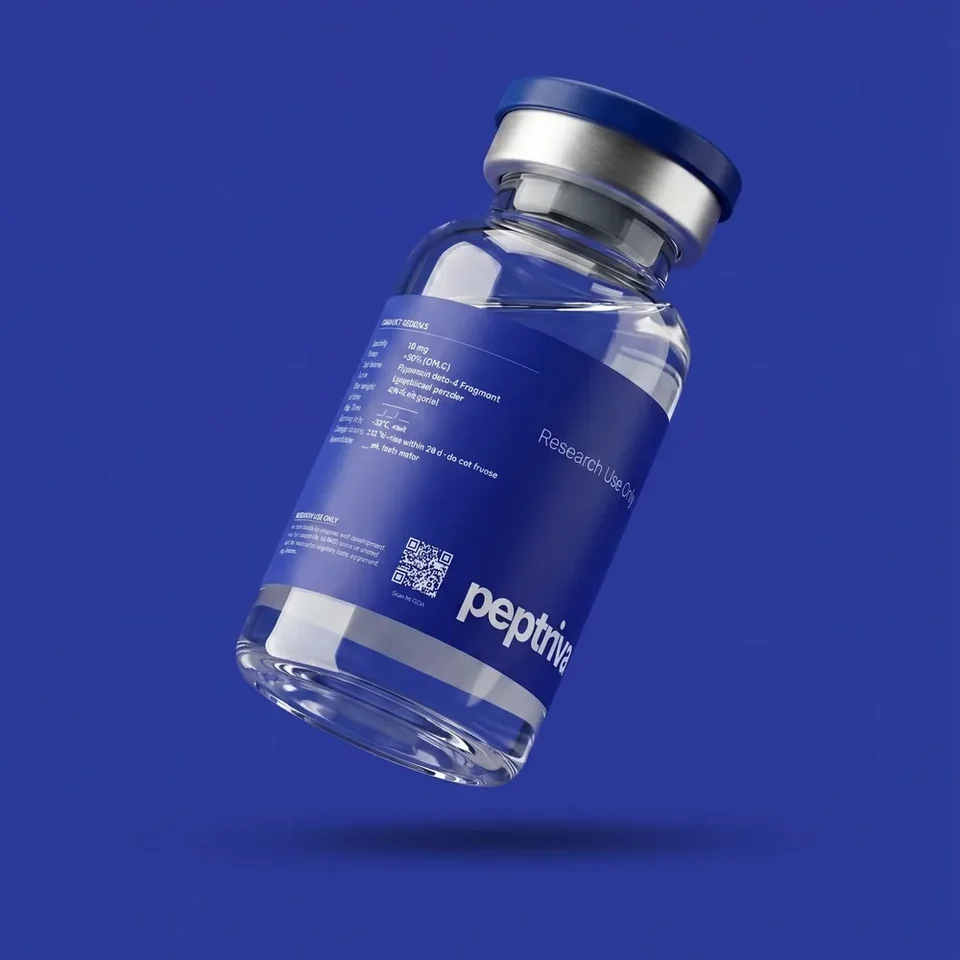
Selank
Referenced in this guideThe Selank referenced throughout this article, supplied as a research compound with a certificate of analysis matched to the lot you receive — the check this site argues you should hold any supplier to.
Selank is a synthetic 7-amino-acid analog of tuftsin, a natural immune-signaling peptide from Russia’s V.V. Zakusov Research Institute, and it won Russian approval as an anxiolytic in 2009. It isn’t FDA-approved, so here it’s a research compound at $40–$80 per 10 mg vial. Watch for two red flags: plain tuftsin sold as Selank, and any vendor claiming US approval.
The 60-second answer. Buy lyophilized powder from a research-supply vendor. Insist on a third-party CoA from an ISO 17025-accredited lab: HPLC ≥98%, mass-spec at 793.9 g/mol, CAS 129954-34-3. The sequence should read Thr-Lys-Pro-Arg-Pro-Gly-Pro, with the N-acetylation spelled out. You'll pay $40–$80 per 10 mg vial.
Where can you buy Selank?
In the US you can buy Selank from a research-supply vendor, and that's the only route that works. A Russian pharmacy dispenses it as an approved nasal drop, but importing it is a legal grey zone. No US prescription exists, because Selank isn't FDA-approved.
- A research-supply vendor. The standard US route, and in practice the only one. Lyophilized powder under Research Use Only labeling, no prescription.
- A Russian pharmacy. Russia approves Selank-0.15% as a nasal-drop, so it's a real prescription product there. Bringing it into the US is a legal grey zone, and customs seizes these shipments routinely.
- A US prescription. Closed. Selank isn't FDA-approved, so there's nothing for a doctor to write.
What the research route leaves out. No physician, no FDA-regulated batch testing, and no Western trial evidence to lean on. Zero PubMed-indexed randomized human trials of Selank for anxiety have been published. The Russian approval rests on Russian-language clinical work that mostly sits outside PubMed.
Six vendors, all checked on 13 August 2026 against what each will show you before you pay: a third-party certificate you can open, and whether the testing lab is named in the vendor's own copy or only inside the PDF. We did not verify Selank prices, so there is no price column here — pricing across these same vendors is benchmarked on BPC-157 in our full vendor comparison, where the spread runs $6.30–$12.45 per mg. Stock varies by compound, so check each catalogue for Selank.
| Vendor | COA | Lab named | Ships free at |
|---|---|---|---|
| Peptriva Premium brand | Third-party, published | Product page (Freedom Diagnostics) | $200 |
| Sports Technology Labs | Third-party, published | Site and document (MZ Biolabs, Colmaric) | $149 |
| Swiss Chems | Third-party, published | Site FAQ (Janoshik) | $100 |
| Core Peptides | Third-party, published (A2LA #6377.01.01) | Document only (Vanguard Laboratory) | $200 |
| PS Peptides | Third-party, published | Document only (North American Diagnostics) | $200 |
| Red Rock Peptides | Claimed, none published | Not named | Not offered |
Three caveats travel with that table. Peptriva and Red Rock sell 10 mg vials only, so their per-milligram figures in the BPC-157 benchmark are not comparable with a 5 mg row. Swiss Chems sells its BPC-157 as the arginine salt rather than the plain peptide, so it is not a like-for-like product. And Red Rock publishes no certificate of analysis at all, despite advertising verified COAs. Where To Buy Peptides earns a commission on purchases made through its links, Peptriva included — see our disclosure.
The identity check specific to Selank: CAS 129954-34-3 on the identity line. Our verified set holds no observed mass for it, so ask for the sequence written out in full instead — substituting plain tuftsin for the N-acetylated 7-mer is the trap this compound is known for.
What is Selank?
Selank carries the research code TP-7. It's a synthetic analog of tuftsin, a natural 4-residue immune peptide reading Thr-Lys-Pro-Arg that your body cuts from immunoglobulin G. Selank keeps that core, extends it with Pro-Gly-Pro so enzymes can't chew it up as fast, and caps the N-terminus with an acetyl group.
The N-acetylation matters. Unacetylated tuftsin is a different molecule with a different evidence base. Some grey-market suppliers sell tuftsin under the Selank label. The molecule of record in the Russian approval is the full N-acetylated 7-mer.
A 2022 rat study reported anxiolytic activity at 0.3 mg/kg, with performance "slightly inferior" to diazepam in a morphine-withdrawal model.
“
Selank modulated right amygdala functional connectivity within 5–20 minutes of intranasal administration in 52 healthy adults.
— Panikratova et al., 2020. The one rigorous Western imaging study.
“
Selank, a peptide analog of tuftsin, attenuates aversive signs of morphine withdrawal in rats.
— Konstantinopolsky et al., Bulletin of Experimental Biology and Medicine, 2022. A rat study, and we'd read it as one.
How do you verify Selank before you buy?
Four checks decide whether a Selank vial is what it claims. What the Russian approval actually covers. The tuftsin-analog identity on the CoA. Powder against nasal spray. And whether the vendor keeps its claims honest. The standard eight vendor criteria apply on top.
1. What Russian approval does and doesn't mean
Selank has real regulatory approval in Russia, granted in 2009 and sustained since. That approval rests on Russian-language clinical trials that mostly sit outside the PubMed-indexed literature.
So Selank has more clinical history behind it than the typical grey-market peptide. None of that history transfers to FDA or EMA validation. We'd put it as "Russian-approved, Western research-only." Any vendor telling you Selank is FDA-approved is simply wrong.
2. Tuftsin-analog identity verification
The CoA should list the 7-residue sequence with the N-acetylation spelled out, CAS 129954-34-3, and MW 793.9 g/mol. Mass-spec should read [M+H]+ near 794.9, within half a dalton. A different mass means a different compound: unacetylated tuftsin, a truncated synthesis product, or something else nobody has named.
3. Lyophilized powder vs nasal spray
Russian clinical Selank is a nasal-drop solution called Selank-0.15%. Western research vendors sell lyophilized powder. Same molecule, different vehicle.
The powder keeps longer and is the standard reference form here. Published studies have used the intranasal route, matching Russian clinical practice, or the intraperitoneal route, matching the rodent literature. We'd skip any pre-mixed nasal spray that won't disclose its vehicle, preservative and stability window.
4. Anxiolytic-claim discipline
A Research Use Only vendor should tell you what the molecule is and what the published evidence reports. Clinical claims cross into FDA jurisdiction. The cleanest signal you can look for is a product page that cites the Russian approval honestly and stops short of saying Selank treats anything.
What does Selank cost in 2026?
Selank costs $40–$80 per 10 mg vial in 2026, or $4–$8 per mg. It's 7 residues with one modification, the N-acetylation. That's low-end synthesis complexity, and the price shows it. Here's the 2026 map.
- 5 mg vial: $30–$55 ($6–$11/mg). Less commonly stocked.
- 10 mg vial: $40–$80 ($4–$8/mg). Most common size. Best per-mg value.
- 20 mg vial: $70–$140 ($3.50–$7/mg).
- Multi-vial discounts: 10–25% off for 3-pack or 6-pack purchases.
Below $30 per 10 mg vial, doubt the N-acetylation step and the HPLC purification that separate a crude 7-mer from real Selank. Above $15 per mg, you're paying retail markup rather than synthesis cost.
Is Selank legal to buy?
Selank is legal to buy in the US as a research reference compound, and illegal to sell for human consumption. Russia is the only country that has approved it as a medicine. Selank's regulatory geography is genuinely unusual, so here it is in full.
- FDA / EMA: Not approved for anything. No U.S. clinical trials.
- Russia: approved by the Ministry of Health in 2009 for generalized anxiety disorder, as the Selank-0.15% nasal drop. The supporting trials are in Russian and largely outside PubMed.
- U.S. legal status: bought and sold as a research reference compound under Research Use Only labeling, 21 CFR § 809.10(b)(9). Selling it for human consumption is illegal.
- WADA: Not explicitly listed. Athletes should still consult their sport’s anti-doping authority.
What are the red flags when buying Selank?
Seven things would stop us buying a Selank vial. Two of them are specific to this compound: a claimed US approval that doesn't exist, and cheaper tuftsin wearing the Selank label.
- “FDA-approved Selank.” False. Suppliers claiming U.S. approval are misrepresenting the regulatory state.
- Tuftsin sold as Selank. Tuftsin is the 4-residue precursor (Thr-Lys-Pro-Arg). Selank is the N-acetylated 7-mer (Thr-Lys-Pro-Arg-Pro-Gly-Pro). Different molecules.
- Clinical claims on the product page. “Treats GAD.” “Cures PTSD.” FDA jurisdiction.
- Missing CAS 129954-34-3. The unique identifier. Its absence is a red flag.
- Mass-spec not matching 793.9 g/mol. Wrong mass, wrong molecule.
- Pre-mixed nasal sprays without vehicle disclosure. A solution should state its vehicle, preservative, concentration and stability window. Otherwize, take the powder.
- Internal QC only, no third-party ISO 17025 lab. An outside accredited lab is the standard.
Selank
N-acetylated heptapeptide, CAS 129954-34-3. The same reference compound used across the Russian clinical literature underpinning the 2009 anxiolytic approval and the Western preclinical work cited in this guide. COA with HPLC trace and mass-spec ships with every order.
Frequently asked questions
Is Selank legal to buy in the USA?
Yes, as a research reference compound under Research Use Only labeling. It isn't FDA- or EMA-approved. Russia is the only jurisdiction that has approved it, back in 2009, for generalized anxiety disorder. Selling it for human consumption is illegal. Buying it as research material is not.
What does Russian approval mean for a buyer?
It means Selank has genuine approval somewhere, which most grey-market peptides never get. The supporting trials are in Russian and largely outside PubMed, and none of it transfers to FDA or EMA validation. You get more clinical history than usual, and essentially no Western randomized evidence.
How is Selank different from a benzodiazepine?
The literature reports anxiolysis without sedation, without classical withdrawal, and without dependence. The described mechanism is an interaction with GABA, serotonin and dopamine systems, rather than the direct GABA-A modulation a benzodiazepine uses.
A 2022 rat morphine-withdrawal study put Selank's effect "slightly inferior" to diazepam at 2 mg/kg. That's the gentler-anxiolytic positioning in a sentence.
Anxiolytic without sedation — is that a real effect?
It has reproducible preclinical support and exactly one rigorous Western human study. That's the 2020 placebo-controlled fMRI in 52 healthy adults, where Selank modulated right amygdala connectivity within 5–20 minutes of an intranasal dose. No Western trial using a standardized anxiety rating scale has been published in PubMed.
How does Selank compare to Semax?
Both are short Russian heptapeptides carrying Pro-Gly-Pro stability extensions, both approved in Russia, both research-only in the West. Selank is a tuftsin analog positioned as an anxiolytic. Semax is an ACTH fragment analog positioned around cognition and neuroprotection. We run the full comparison in Selank vs Semax.
Lyophilized powder vs nasal drops?
Russian clinical Selank is the Selank-0.15% nasal drop. Western research Selank is almost always lyophilized powder for reconstitution. The molecule is identical, and the powder keeps longer. Published Western studies used either the intranasal route, matching Russian clinical practice, or the intraperitoneal route, matching the rodent work.
What to know now
- One route in the US, and it isn't a pharmacy. A research-supply vendor. The Russian pharmacy route is real but the import isn't reliable.
- CAS 129954-34-3, MW 793.9 g/mol, sequence Thr-Lys-Pro-Arg-Pro-Gly-Pro, N-acetylated. The numbers a credible CoA should show.
- $40–$80 per 10 mg vial. Seven residues and one N-acetylation put it among the simpler peptides to make.
- Russian-approved since 2009; not FDA- or EMA-approved. Real pharmaceutical approval, but only in Russia. Western use is research-only.
- N-acetylated heptapeptide only. Unacetylated tuftsin sold as Selank is the wrong molecule.
- Lyophilized powder is the Western research form. Skip nasal sprays that won't disclose their vehicle.
- Anxiolysis without sedation is the literature positioning. Western RCT evidence for anxiety treatment is essentially absent; preclinical and fMRI support exist.
What we’re watching
The Selank development we're waiting on is a Western randomized trial: a generalized anxiety population, a validated rating scale, a placebo arm. The Russian approval rests on clinical work you can't search in PubMed, and the only rigorous Western human evidence is still the 2020 fMRI study.
Until that trial runs, Selank stays in its odd category. It's a real Russian pharmaceutical with a credible preclinical signal and no validation by Western standards. We're also watching the WADA Prohibited List. Selank isn't on it, but the whole category is moving.
References
- Panikratova, Y. R., Lebedeva, I. S., Sokolov, O. Y., Rumshiskaya, A. D., Kupriyanov, D. A., Kost, N. V., & Myasoedov, N. F. (2020). Functional connectomic approach to studying Selank and Semax effects. Doklady Biological Sciences, 490(1), 9–11. https://doi.org/10.1134/S001249662001007X
- Konstantinopolsky, M. A., Chernyakova, I. V., & Kolik, L. G. (2022). Selank, a peptide analog of tuftsin, attenuates aversive signs of morphine withdrawal in rats. Bulletin of Experimental Biology and Medicine, 173(6), 730–733. https://doi.org/10.1007/s10517-022-05624-x
- Yasenyavskaya, A. L., Samotrueva, M. A., Tsibizova, A. A., Bashkina, O. A., Myasoedov, N. F., & Andreeva, L. A. (2021). The influence of Selank on the level of cytokines under the conditions of “social” stress. Current Reviews in Clinical and Experimental Pharmacology, 16(2), 162–167. https://doi.org/10.2174/1574884715666200704152810
- Mukhina, A. Y., Mishina, E. S., Bobyntsev, I. I., Medvedeva, O. A., Svishcheva, M. V., & Andreeva, L. A. (2020). Morphological changes in the large intestine of rats subjected to chronic restraint stress and treated with Selank. Bulletin of Experimental Biology and Medicine, 169(2), 281–285. https://doi.org/10.1007/s10517-020-04868-9
- International Organization for Standardization. (2017). ISO/IEC 17025:2017 — General requirements for the competence of testing and calibration laboratories. https://www.iso.org/standard/66912.html
- U.S. Food and Drug Administration. (n.d.). Research Use Only (RUO) and Investigational Use Only (IUO) products — 21 CFR § 809.10(b)(9). https://www.fda.gov/medical-devices/ivd-regulatory-assistance/distribution-vitro-diagnostic-products-labeled-research-use-only-or-investigational-use-only
- World Anti-Doping Agency. (2026). The Prohibited List. https://www.wada-ama.org/en/prohibited-list