
You can buy IGF-1 LR3 from research-supply and life-science reagent vendors online, and that's the only route, which is the plain answer to where to buy IGF-1 LR3. No pharmacy dispenses it, because the approved medicine in this family is a different molecule.
IGF-1 LR3 is sold by research suppliers only, and nobody prescribes it. It's an engineered 83-residue analog, long enough that quality varies far more than it does for short peptides. It's the one compound here where correct folding matters as much as sequence purity, and it has the thinnest human safety data in the growth-hormone field.
Where can you buy IGF-1 LR3?
IGF-1 LR3 is sold by peptide research suppliers and by life-science reagent catalogs, both online and both under research-use labeling. That's one channel in two flavors, and no pharmacy route exists at all.
- Peptide research suppliers, online. The route most buyers take. Freeze-dried powder, research-use-only labeling, no prescription.
- Life-science reagent catalogs. Long R3 IGF-1 is a standard cell-culture supplement, so mainstream lab suppliers stock it. Documentation tends to be better here. So does the price.
- Pharmacy, retail or compounding. Closed. The approved product in this family is mecasermin, a recombinant IGF-1 sold as Increlex for severe IGF-1 deficiency. That's plain IGF-1, not the LR3 analog, and it's exactly the molecule a cheap vial substitutes.
We think the pharmacy row is worth reading twice. The thing you can get prescribed and the thing you searched for are different molecules, and one is the classic counterfeit for the other.
What the research-supply route doesn't give you. No prescriber, no regulated batch release, and no folding data unless you ask for it. For an 83-residue protein, that last gap is the one that actually decides whether the vial works.
Which vendors should be on your IGF-1 LR3 shortlist?
That single channel still contains careful suppliers and careless ones, so here is the shortlist. Of the 16 storefronts we checked on 13 August 2026, these six published the most. The columns describe the vendor rather than its catalog, and for this compound a life-science reagent catalog may document a lot better than any of them — confirm IGF-1 LR3 is stocked, and ask what the certificate covers. Pricing across this set is benchmarked on BPC-157, the one compound all six carry; no IGF-1 LR3 price was verified across these vendors, so no price column appears here.
| Vendor | COA | Lab named | Ships free at |
|---|---|---|---|
| Peptriva Premium brand | Third-party, published | Freedom Diagnostics — on the product page | $200 |
| Sports Technology Labs | Third-party, published | MZ Biolabs and Colmaric — on the site and the document | $149 |
| Swiss Chems | Third-party, published | Janoshik — on the site | $100 |
| Core Peptides | Third-party, published (A2LA #6377.01.01) | Vanguard Laboratory — document only | $200 |
| PS Peptides | Third-party, published | North American Diagnostics — document only | $200 |
| BioTech Peptides | Third-party, published | MZ Biolabs — document only | $200 |
Three vendors from the same survey are absent on purpose. Red Rock Peptides advertises “Verified With COAs” and publishes no certificate at all. Limitless Biotech gates every price behind an account, so nothing it offers can be compared against anything. Behemoth Labz does publish, but its newest genuine certificate is dated August 2024. The full ranking, with the price column, is in our comparison of peptide companies. Disclosure: this site earns a commission on purchases made through its links, Peptriva included — which is why every column above is a document you can open or a figure you can load for yourself.
No verified CAS number or reference mass for IGF-1 LR3 sits in the dataset behind this table, so require the certificate to supply them: a mass-spec line confirming the LR3 modification — the 13-residue N-terminal extension and the arginine swap that separate it from plain recombinant IGF-1 — plus whatever folding or bioactivity data the supplier holds, because a purity figure cannot detect misfolding.
Why is IGF-1 LR3 harder to make than other peptides?
IGF-1 LR3 is harder to make because it's long and structured. Most peptides in this library run 4 to 40 residues. IGF-1 LR3 is 83, with three disulphide bonds that have to form correctly for the molecule to be active.
That puts it closer to a small protein than a peptide, and it changes the failure modes. A batch can be the right sequence at high HPLC purity and still be substantially misfolded. No purity number will tell you that.
Practically, production is usually recombinant rather than solid-phase. The quality gap between suppliers is wider than for anything short.
“
Intranasal long R3 insulin-like growth factor-1 treatment promotes amyloid plaque remodeling in cerebral cortex but fails to preserve cognitive function.
Engel et al., Journal of Alzheimer's Disease, 2024, male 5XFAD mice
We quote that title in full because the second half is the part people skip. A measurable tissue change and no functional benefit is a common shape in this literature.
“
High-Performance Liquid Chromatography of Peptides and Proteins: Separation, Analysis, and Conformation.
Mant & Hodges, CRC Press, 1991. Conformation is the third word for a reason
What should you check before buying IGF-1 LR3?
Check IGF-1 LR3 for mass-spec identity confirming the LR3 modification, HPLC purity, and any bioactivity or folding data the supplier holds. Then check endotoxin and cold chain. The table says why each one bites harder for an 83-residue protein.
| Check | Why it matters here |
|---|---|
| Mass spec identity | Confirms the LR3 modification is present — plain IGF-1 is a different, cheaper molecule |
| HPLC purity | Necessary but not sufficient; it does not detect misfolding |
| Bioactivity or folding data | Rare, and the single most informative thing a supplier can provide for this compound |
| Endotoxin | Recombinant production means bacterial expression systems; this is a real consideration, not a formality |
| Cold chain | Larger, structured molecules are less forgiving of transit temperature |
"LR3" is the part that gets substituted. Long R3 IGF-1 is IGF-1 with an arginine swap and a 13-residue N-terminal extension, engineered to reduce binding-protein affinity. Plain recombinant IGF-1 is cheaper and looks the same on a label. Mass spec separates them by molecular weight. Nothing on the vial does.
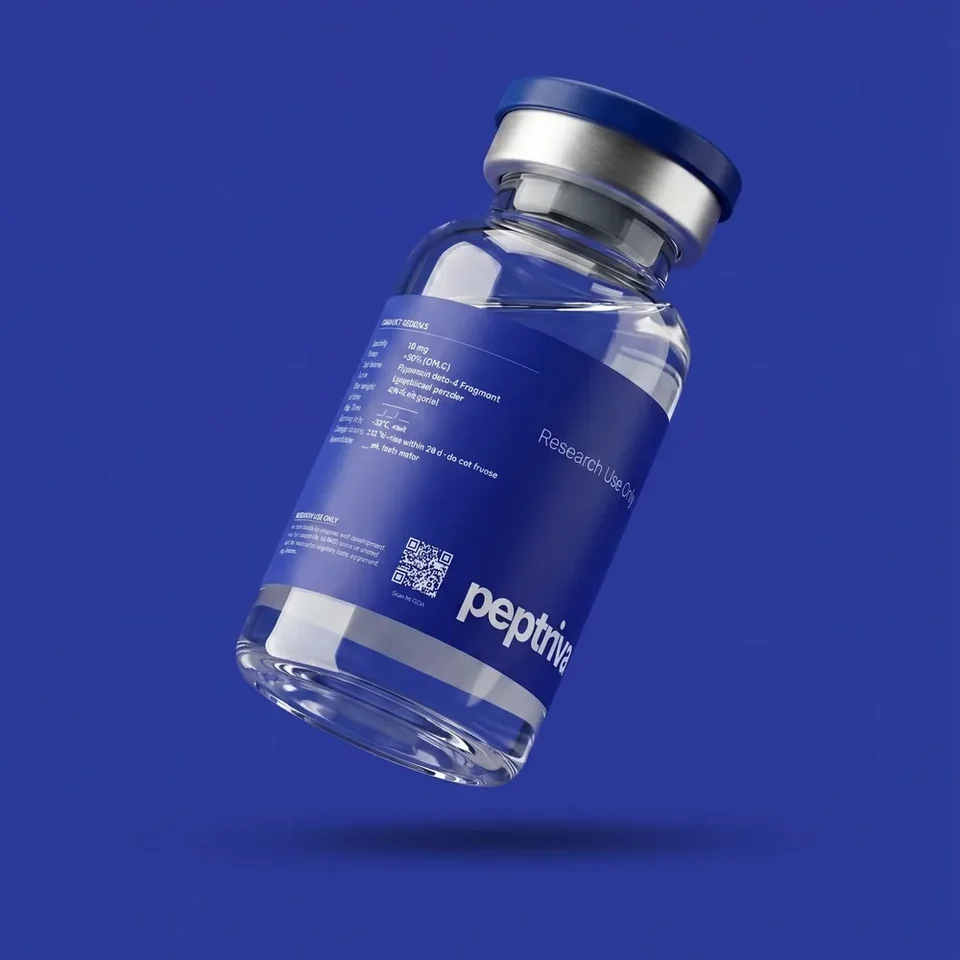
Research compounds
Third-party tested research compounds, each with a batch-matched certificate of analysis showing HPLC purity and mass-spec identity.
What are the red flags when buying IGF-1 LR3?
The IGF-1 LR3 red flag we weigh heaviest is a certificate that reports purity and nothing about structure. Four more:
- A COA that only reports purity. For an 83-residue protein that's half an answer. Ask what confirms the fold.
- A price near plain IGF-1. The LR3 version costs more to make. Parity is a hint about which one is in the vial.
- No endotoxin figure. Bacterial expression is the standard production route, so the question isn't exotic. Silence usually means untested.
- Ambient shipping with no cold pack. A structured protein that has spent a week warm may be intact on paper and dead in practice.
- Human dosing advice from the seller. This compound has the thinnest human record in its field. Anyone confident about a dose isn't reading the same literature we are.
The complete guide covers the mechanism and the evidence base, including how little of it is human.
Frequently asked questions
Can you buy IGF-1 LR3 from a pharmacy?
No. The approved medicine in this family is mecasermin, a recombinant IGF-1 marketed as Increlex for severe primary IGF-1 deficiency. That's the plain hormone, not the LR3 analog, and no pharmacy stocks LR3 itself.
What is the difference between IGF-1 and IGF-1 LR3?
LR3 is IGF-1 with an arginine substitution at position 3 and a 13-residue N-terminal extension, engineered to reduce binding-protein affinity so more circulates free. Plain IGF-1 is a different and cheaper molecule that looks similar on a label.
Why is IGF-1 LR3 harder to source than other peptides?
At 83 residues with three disulphide bonds it's closer to a small protein than a peptide. It's usually produced recombinantly rather than by solid-phase synthesis, and a batch can be the right sequence at high purity and still be misfolded.
Does HPLC purity tell you if IGF-1 LR3 is folded correctly?
No. HPLC measures the share of material eluting as the target peak. Folding is a structural property that purity assays don't assess, which is why bioactivity data is unusually valuable for this compound.
Is endotoxin a real concern for IGF-1 LR3?
More than for short synthetic peptides, because recombinant production uses bacterial expression systems. Endotoxin is heat-stable, and it isn't what an HPLC purity figure measures.
Research compounds
Third-party tested research compounds, each shipped with a batch-matched certificate of analysis showing HPLC purity and mass-spec identity — the documentation this site argues you should hold any supplier to.
What to know now
- One route only. Research and reagent suppliers online. The prescribable IGF-1 product is a different molecule.
- It runs to 83 residues. That is long for a synthetic peptide, so quality varies far more than it does for short ones.
- Folding matters as much as purity. A correct sequence that has folded wrongly is still the wrong product in the vial.
- LR3 is the substitution point. The modification is what makes this analog distinct, and it is what a cheap vial is likeliest to lack.
- Purity alone answers nothing here. A percentage cannot tell you whether an 83-residue chain assembled into the right structure.
- Human safety data are the thinnest here. IGF-1 LR3 has less human evidence behind it than anything else in the growth-hormone field.
What we're watching
Whether any supplier starts shipping folding or bioactivity data as standard. It's the one document that would change how this compound is bought, and right now almost nobody provides it. We're also watching the reagent-catalog side of the market. Those vendors already publish activity assays for cell-culture customers, and that documentation habit is the thing the peptide side lacks.
References
- Engel, M. G., Narayan, S., Cui, M. H., et al. (2024). Intranasal long R3 insulin-like growth factor-1 treatment promotes amyloid plaque remodeling in cerebral cortex but fails to preserve cognitive function in male 5XFAD mice. Journal of Alzheimer’s Disease, 103(1), 113–126. https://doi.org/10.1177/13872877241299056
- White, A., Stremming, J., Boehmer, B. H., et al. (2021). Reduced glucose-stimulated insulin secretion following a 1-wk IGF-1 infusion in late gestation fetal sheep is due to an intrinsic islet defect. American Journal of Physiology — Endocrinology and Metabolism, 320(6), E1138–E1147. https://doi.org/10.1152/ajpendo.00623.2020
- Mant, C. T., & Hodges, R. S. (Eds.). (1991). High-Performance Liquid Chromatography of Peptides and Proteins: Separation, Analysis, and Conformation. Boca Raton, FL: CRC Press. https://doi.org/10.1201/9780203751947
- Thomas, A., Walpurgis, K., & Thevis, M. (2024). Chromatographic-mass spectrometric analysis of peptidic analytes in doping control urine samples. Journal of Mass Spectrometry, 59(1), e4996. https://doi.org/10.1002/jms.4996
- International Organization for Standardization. (2017). ISO/IEC 17025:2017 — General requirements for the competence of testing and calibration laboratories. https://www.iso.org/standard/66912.html