
You can buy DSIP from research-supply vendors online, and that's the only route. No pharmacy stocks it and no prescriber can write for it. Where to buy DSIP therefore comes down to picking a vendor who'll be honest about a compound isolated in 1977 with zero modern Western controlled trials behind it.
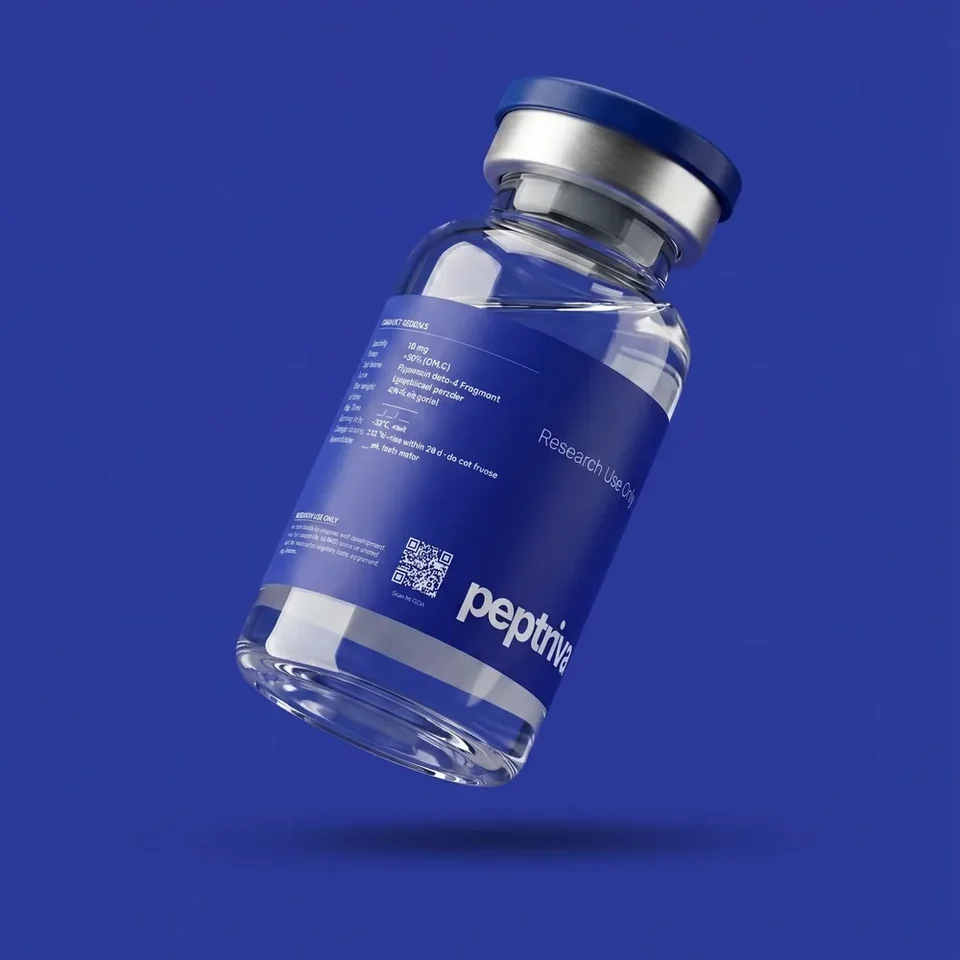
DSIP
Referenced in this guideThe DSIP referenced throughout this article, supplied as a research compound with a certificate of analysis matched to the lot you receive — the check this site argues you should hold any supplier to.
DSIP is available only as a research compound at $40–$80 per 5 mg vial. It's a 9-amino-acid chain, CAS 62568-57-4, molecular mass 848.82 g/mol, and both belong on the certificate. Two caveats outweigh the pricing: 50 years of research has identified no DSIP target in the brain, and no modern controlled trial substantiates the sleep claim.
Sourcing summary: Third-party tested DSIP typically runs $40–$80 per 5 mg vial. A Certificate of Analysis from an ISO 17025-accredited lab should show HPLC purity above 98% and mass-spec at 849.8.
Published preclinical studies used lyophilized powder, meaning freeze-dried. Oral capsules, sprays and patches haven't been validated in any peer-reviewed study. Vendors making clinical sleep-treatment claims are overstating the evidence base.
Where can you buy DSIP?
DSIP comes from research-supply vendors online, sold as a reference compound under Research Use Only labeling. There's no prescription route and no realistic pharmacy route, because DSIP has never been approved for any indication anywhere.
- Research-supply vendor: The working route. Lyophilized DSIP powder, no prescription, and the only channel most buyers will find.
- Compounding pharmacy: Effectively closed. The FDA hasn't categorized DSIP under the 503A bulk-substances framework, so pharmacies are working without a clearance and almost always decline.
- Retail pharmacy on prescription: Closed. DSIP isn't an approved drug in any country, so there's no product to dispense.
That leaves you choosing between vendors rather than between channels. We think the honest measure of a DSIP vendor is how they describe the evidence, not how they describe the molecule.
Six vendors, all checked on 13 August 2026 against what each will show you before you pay: a third-party certificate you can open, and whether the testing lab is named in the vendor's own copy or only inside the PDF. We did not verify DSIP prices, so there is no price column here — pricing across these same vendors is benchmarked on BPC-157 in our full vendor comparison, where the spread runs $6.30–$12.45 per mg. Stock varies by compound, so check each catalogue for DSIP.
| Vendor | COA | Lab named | Ships free at |
|---|---|---|---|
| Peptriva Premium brand | Third-party, published | Product page (Freedom Diagnostics) | $200 |
| Sports Technology Labs | Third-party, published | Site and document (MZ Biolabs, Colmaric) | $149 |
| Swiss Chems | Third-party, published | Site FAQ (Janoshik) | $100 |
| Core Peptides | Third-party, published (A2LA #6377.01.01) | Document only (Vanguard Laboratory) | $200 |
| PS Peptides | Third-party, published | Document only (North American Diagnostics) | $200 |
| Red Rock Peptides | Claimed, none published | Not named | Not offered |
Three caveats travel with that table. Peptriva and Red Rock sell 10 mg vials only, so their per-milligram figures in the BPC-157 benchmark are not comparable with a 5 mg row. Swiss Chems sells its BPC-157 as the arginine salt rather than the plain peptide, so it is not a like-for-like product. And Red Rock publishes no certificate of analysis at all, despite advertising verified COAs. Where To Buy Peptides earns a commission on purchases made through its links, Peptriva included — see our disclosure.
The identity check specific to DSIP: CAS 62568-57-4 on the identity line, and a molecular mass of 848.82 g/mol.
What is DSIP, exactly?
DSIP is a chain of nine amino acids, sequence Trp-Ala-Gly-Gly-Asp-Ala-Ser-Gly-Glu, written WAGGDASGE for short. No modifications, no cyclic structure, no D-amino acids. DSIP is about as simple as a synthetic peptide gets.
Swiss researchers Schoenenberger and Monnier isolated it in 1977 from rabbit blood collected during electrically-induced sleep. That’s where the name comes from. The 1977 paper reported that DSIP increased delta-wave sleep in rabbits.
Modern work has revised the picture. A 2024 study built a fusion peptide to help DSIP cross the blood-brain barrier, and found plain DSIP didn't work as well as the engineered version, per Mu and colleagues. That fits a long-standing concern: unmodified DSIP probably doesn't reach the brain well.
That doesn’t make DSIP fake. It’s a real, structurally defined molecule with a real preclinical literature. It does mean an honest vendor talks about it differently from a vendor leaning on 1977 marketing.
“
Delta sleep-inducing peptide recovers motor function in SD rats after focal stroke.
Tukhovskaya et al., Molecules, 2021
That is where the live DSIP research actually is. If you came for sleep, the modern papers you will find are about stroke.
What should you check before buying DSIP?
Check DSIP for CAS 62568-57-4 on the identity line, a mass-spec peak at 849.8, and a vendor who says out loud that the brain target is unidentified. The general eight peptide-buyer criteria apply on top. These four matter more for DSIP:
1. The CAS number must be 62568-57-4
CAS 62568-57-4 is the unique chemical ID for standard DSIP. The CoA should list it on the identity line alongside the WAGGDASGE sequence. Cross-check it against PubChem in 30 seconds. A missing CAS, or one that doesn't resolve to DSIP, is a critical gap.
2. The target is still unidentified after 50 years
The missing DSIP target is the cleanest test of vendor honesty we know. Multiple decades of work have not located a specific brain target. Nothing cloned, no high-affinity binding partner confirmed.
A vendor whose product page acknowledges that is matching the actual state of the science. A vendor describing DSIP as “the peptide that activates the DSIP target” is overstating it.
3. The sleep evidence is thin
The 1977 paper observed delta-wave sleep in rabbits. That single observation, in one species, in one lab, is the foundation of essentially all DSIP sleep marketing. Some small studies followed in the 1980s and 1990s.
No modern randomized controlled trial has tested DSIP for sleep with proper rigor: randomization, blinding, validated polysomnography. We'd call the sleep evidence suggestive, not confirmed.
4. The literature has moved away from sleep
The modern Russian preclinical program at the Shemyakin-Ovchinnikov Institute has largely shifted from sleep to stroke reperfusion injury. See Tukhovskaya 2021a and 2021b. That's where the recent signal sits, not in sleep. A vendor still marketing sleep claims is ignoring what the science says.
Where this falls short: DSIP's evidence problem is the headline story. The 1977 rabbit isolation has never been replicated to modern standards, and the receptor remains unidentified. There are zero modern Western randomized controlled trials.
The marketing rests on a 50-year-old paper and small observations from earlier decades. We'd describe DSIP as a real research peptide with real preclinical work in stroke models, and not as a validated sleep treatment.
“
DSIP-like KND peptide reduces brain infarction in C57Bl/6 and reduces myocardial infarction in SD rats when administered during reperfusion.
Tukhovskaya et al., Biomedicines, 2021
What does DSIP cost in 2026?
DSIP costs $40–$80 for a 5 mg vial and $70–$130 for 10 mg. It's one of the simplest peptides on the research market: nine amino acids, no modifications, well-established synthesis. Here's what we see at third-party tested retail in 2026:
- 5 mg vial: $40–$80 per vial. Standard retail size.
- 10 mg vial: $70–$130 per vial. Better per-mg value.
- Multi-vial tiers: 10–20% off for 3- or 6-pack orders.
Below $30 per 5 mg vial deserves a question. The cheap end usually skips HPLC purification, not synthesis steps. Above $100 per 5 mg vial, you’re paying retail markup.
Is DSIP legal to buy?
Yes, easily. DSIP isn't FDA-approved for any indication, isn't a controlled substance, isn't scheduled by the DEA, and isn't listed on the WADA 2026 Prohibited List. Sales operate under 21 CFR § 809.10(b)(9), the Research Use Only labeling rule.
What that simplicity doesn't protect against is marketing claims. A vendor calling DSIP a “sleep treatment” or “insomnia remedy” is making clinical claims about an unapproved drug.
That triggers FDA enforcement regardless of the chemical's status. The legal product is a research compound. The illegal product is the same chemical sold with human-use claims.
What are the red flags when buying DSIP?
The DSIP red flag we weigh heaviest is a clinical sleep claim, because no modern trial supports one. Six warning signs we’d skip:
- Clinical sleep claims. “DSIP treats insomnia.” “DSIP regulates delta-wave sleep.” FDA enforcement territory for an unapproved peptide with no Western RCT base.
- Talking about “the DSIP target.” There isn’t one. 50 years of investigation hasn’t found a specific binding partner. A vendor pretending otherwize is overstating the science.
- Oral capsules, sublingual sprays, or transdermal patches. None validated in any peer-reviewed study. The literature uses injectable or intranasal lyophilized peptide.
- Pre-mixed liquid at room temperature. Powder survives shipping. Liquid degrades fast.
- Missing CAS 62568-57-4 or mass-spec result not at 849.8. Wrong ID, wrong molecule.
- Vendor’s in-house QC instead of third-party testing. Independent ISO/IEC 17025 verification is the third-party tested standard.
DSIP
Standard 9-residue nonapeptide, CAS 62568-57-4, sequence WAGGDASGE. The same reference compound used across the modern Russian-school preclinical literature. COA with HPLC trace and mass-spec ships with every order.
Frequently asked questions
Is DSIP legal to buy in the USA?
Yes, as a research reference compound. The FDA hasn’t approved DSIP for any indication. It’s not a controlled substance and not on the WADA Prohibited List. Selling DSIP for human consumption is illegal. Buying it as research material isn’t.
Is there human trial evidence behind the DSIP sleep-induction claim?
No modern Western controlled trials of DSIP for sleep, stress, or any other indication have been published in the 2020–2026 window. The marketing rests on the 1977 rabbit isolation and a few small observational studies from earlier decades. No peer-reviewed sleep-trial evidence base has emerged in the modern literature.
Why has the DSIP target never been identified?
Multiple decades of search work have not found a specific brain target for DSIP. Three explanations are plausible. DSIP may act indirectly rather than through one high-affinity binding partner. The 1977 isolation may have captured a biological signature without nailing the right molecule. Or the active fraction was a breakdown product. The target remains unconfirmed.
What forms of DSIP are sold?
third-party tested DSIP is sold as a lyophilized powder. The preclinical literature has used reconstitution in bacteriostatic water or sterile saline; the 2021 Tukhovskaya stroke studies employed intranasal administration at 120 µg/kg in rodent models. Oral capsules, sublingual sprays, and patches have not been validated in any peer-reviewed study.
How much should DSIP cost?
9 amino acids with no modifications keeps the synthesis cheap. third-party tested pricing typically runs $40–$80 for a 5 mg vial or $70–$130 for 10 mg. Below that range, purity is the likely trade-off; above it, pricing reflects retail margin rather than synthesis cost.
How does DSIP compare to other sleep peptides?
DSIP, Selank, and Epitalon are the three peptides most commonly marketed for sleep. All three share the same evidence problem: substantial Russian preclinical history, very thin Western controlled-trial data, no FDA approval. Standard FDA-approved sleep aids and validated melatonin have much more rigorous human evidence.
What to know now
- CAS 62568-57-4, MW 848.82, observed [M+H]+ 849.8. The numbers a credible CoA shows.
- $40–$80 per 5 mg vial. 9 amino acids, no modifications — one of the cheapest peptides to make.
- No brain target identified after 50 years. A vendor describing “the DSIP target” is overstating the science.
- Zero modern Western controlled trials. The sleep-induction claim rests on pre-1990s observations, not modern RCT data.
- Lyophilized injectable or intranasal is the literature form. Oral and sublingual aren’t validated.
- Unscheduled, unapproved, unlisted by WADA. The framework is simple; the clinical-claim line is not.
What we’re watching
The big DSIP signal we’re tracking is whether the brain-target question ever resolves. Finding the molecular substrate of the 1977 sleep-induction observation would change DSIP’s evidence trajectory more than anything else could.
We’re also watching whether the Shemyakin-Ovchinnikov Institute program ever produces a Western controlled trial in stroke rather than sleep. That would shift DSIP from grey-market sleep peptide to credible neuroprotection candidate.
Until either happens, DSIP stays what it has been for 50 years. A real molecule with a real preclinical literature, marketed for an indication the literature doesn’t substantiate.
References
- Tukhovskaya, E. A., Shaykhutdinova, E. R., Ismailova, A. M., Slashcheva, G. A., Goryacheva, N. A., Sadovnikova, E. S., Rzhevsky, D. I., Dyachenko, I. A., Frolova, M. S., Rykov, V. A., Kravchenko, I. N., Murashev, A. N., & Ivanov, V. T. (2021). DSIP-like KND peptide reduces brain infarction in C57Bl/6 and reduces myocardial infarction in SD rats when administered during reperfusion. Biomedicines, 9(4), 407. https://doi.org/10.3390/biomedicines9040407
- Tukhovskaya, E. A., Ismailova, A. M., Shaykhutdinova, E. R., Slashcheva, G. A., Goryacheva, N. A., Sadovnikova, E. S., Rzhevsky, D. I., Dyachenko, I. A., Murashev, A. N., & Ivanov, V. T. (2021). Delta sleep-inducing peptide recovers motor function in SD rats after focal stroke. Molecules, 26(17), 5173. https://doi.org/10.3390/molecules26175173
- Mu, X., Qu, L., Yin, L., Wang, L., Liu, X., & Liu, D. (2024). Pichia pastoris secreted peptides crossing the blood-brain barrier and DSIP fusion peptide efficacy in PCPA-induced insomnia mouse models. Frontiers in Pharmacology, 15, 1439536. https://doi.org/10.3389/fphar.2024.1439536
- U.S. Food and Drug Administration. (n.d.). Research Use Only IVD products: Distribution of in vitro diagnostic products labeled Research Use Only or Investigational Use Only. https://www.fda.gov/regulatory-information/search-fda-guidance-documents/distribution-vitro-diagnostic-products-labeled-research-use-only-or-investigational-use-only
- World Anti-Doping Agency. (2026). 2026 Prohibited List. https://www.wada-ama.org/en/prohibited-list
- International Organization for Standardization. (2017). ISO/IEC 17025:2017 — General requirements for the competence of testing and calibration laboratories. https://www.iso.org/standard/66912.html