
Search Semax side effects and you get a tidy list. Dry nose, mild headache, nothing serious. The published human record behind that list is one imaging study in 52 healthy adults from 2020, and it measured brain connectivity, not safety.
The short answer. The only published human Semax study scanned 52 healthy adults in 2020 and measured brain connectivity, not adverse events.
- No adverse event table with a denominator appears in the indexed English literature.
- Russian registration spans close to 30 years, but that label is not a peer-reviewed safety study you can check.
- Animal work places Semax on opioid, GABA, dopamine and serotonin pathways, plus a 1,171-gene expression shift within 24 hours.
Semax has no published safety trial in English. The one human study scanned 52 adults in 2020. It measured brain connectivity, not adverse events. Zero Western randomized trials sit in PubMed. Rat work shows activity at opioid and GABA pathways. The side effect lists online cite nothing you can open.
What the Semax safety record actually contains
Start with what exists. Panikratova and colleagues published a functional connectivity study in 2020, in Doklady Biological Sciences. It scanned 52 healthy adults. The outcome was a change in brain connectivity patterns.
That is the human dataset. It was not designed to catch harm. No adverse event table, no dose escalation, no follow-up period. A connectivity paper is not a safety paper, and nobody involved claimed it was.
Everything else is rats, cells and artificial membranes. We cover the shape of that literature in the Semax complete guide.
| Safety element | What Semax has in the indexed literature |
|---|---|
| Placebo-controlled Western trial | None found |
| Published adverse event table with denominators | None found |
| Dose-escalation safety study in English | None found |
| Long-term follow-up in humans | None found |
| Safety data for injected Semax | None found |
| Human imaging data | One study, 52 adults, 2020 |
An empty side effect column is not the same as a short one. Nobody has published the count. That is the finding.
Why the side effect lists online have no source
Semax has been registered in Russia for close to 30 years. A registered drug has a label, and a label carries a tolerability section. So a list does exist somewhere.
The problem is checkability. That label is not a peer-reviewed safety study, it is not indexed in PubMed, and the post-marketing reports that would sit behind it are not in the English literature. When a vendor page lists "mild nasal irritation" with no citation, there is nothing to open.
- No numerator. How many people reported the effect is never stated.
- No denominator. How many people were asked is never stated.
- No comparison arm. Without placebo, a headache rate means nothing.
- No route match. Russian use is nasal. The research market sells vials for injection.
Compare this with a compound where the trial ran. Our page on Semax before and after makes the same point about efficacy claims: the number people quote was generated by a study that measured something else.
The pathways that could produce side effects
Semax is a seven-amino-acid fragment of ACTH, a 39-amino-acid hormone. Short does not mean inert. The animal literature places it on several systems that drugs are usually watched closely on.
Liu and colleagues published work in the British Journal of Pharmacology in 2025 in spinal cord injury models. The target they identified was the mu opioid receptor gene.
Semax peptide targets the μ opioid receptor gene Oprm1 to promote deubiquitination and functional recovery after spinal cord injury in female mice.
Liu et al., British Journal of Pharmacology, 2025 (paper title)Vyunova and colleagues reported on a second system in Chemical Biology & Drug Design in 2023.
Synthetic corticotropins and the GABA-receptor system: direct and delayed effects.
Vyunova et al., Chemical Biology & Drug Design, 2023 (paper title)Add the gene expression work from Moscow. Filippenkov and Dergunova's groups report that Semax shifts large sets of brain transcripts in rat stroke models, including inflammatory and immune genes, with a rebalancing of 1,171 stroke-disrupted genes inside 24 hours. That work is summarized on the stroke recovery page.
A molecule that moves opioid signaling, GABA signaling and a thousand-gene expression profile is pharmacologically active. Activity is exactly what generates side effects. The absence of reports does not follow from the peptide being small.
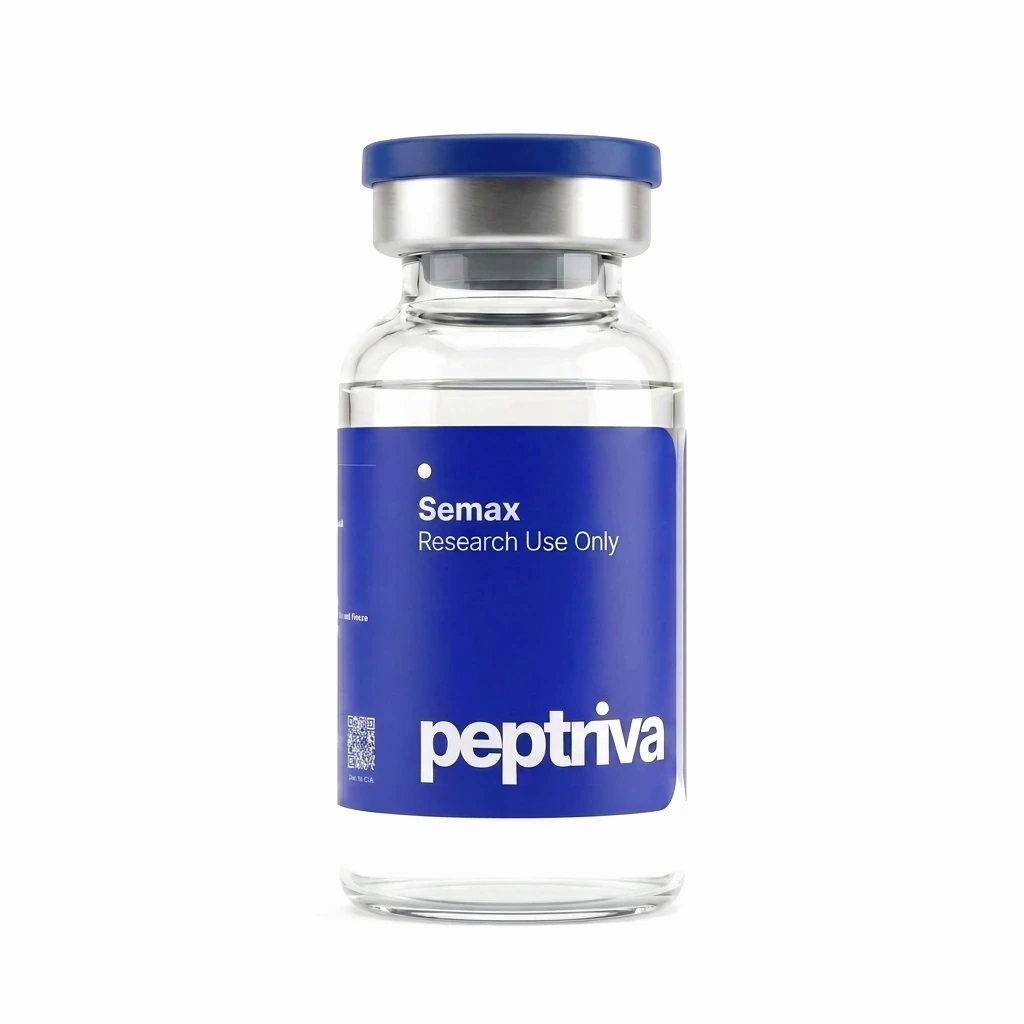
Semax
The compound discussed here, supplied as a research compound with a certificate of analysis matched to the lot.
Does Semax raise cortisol?
No published human study has measured it. That is the honest answer.
The structural argument runs the other way. The parent hormone, ACTH, drives the adrenal glands to make cortisol. Semax keeps the short behavioral fragment and leaves out the region that does the steroid signaling. The mechanism page sets out which residues are kept.
Animal stress models add texture without settling it. Inozemtseva and colleagues, writing in the European Journal of Pharmacology in 2024, tested Semax and Melanotan II in male rats under chronic unpredictable stress and reported antidepressant-like and antistress effects. Glazova's group reported that Semax altered behavior and brain neurochemistry in rats after early-life fluvoxamine exposure. Svishcheva and colleagues looked further out, at the rat large intestine under restraint stress.
Those are rat findings on stress physiology and gut tissue. They show the compound reaches systems beyond cognition. They do not tell you what happens to a human hypothalamic-pituitary-adrenal axis, because nobody has published that measurement.
Nasal drops versus injection: the route with no data
This is the gap that matters most for anyone reading a research vial label.
The Russian registered product is a nasal solution. Its strength works out to 500 µg per drop, and the label range tops out around 20,000 µg a day. Gusev and colleagues reported 12 mg a day for moderate stroke and 18 mg a day for severe stroke in acute care. Those are hospital figures for acute ischemic stroke, reported here and not recommended here. The dosage page lays out what each published source administered.
The research market sells lyophilized powder in vials. We found no published human safety data for Semax given by injection, at any amount, for any indication.
- Route changes exposure. Intranasal and subcutaneous do not produce the same peak or the same distribution.
- Route changes local risk. Nasal mucosa and injection sites fail in different ways.
- Purity is a separate variable. Unverified powder carries risks no peptide study covers. See how to read a certificate of analysis.
What would have to exist before anyone could call it safe
The list is short and none of it is exotic. These are the standard pieces.
- A dose-ranging study in healthy volunteers with a published adverse event table.
- A placebo arm, so background rates of headache and irritability can be subtracted.
- Follow-up past the treatment window, since the GABA work describes delayed effects.
- Interaction data for people taking opioid, GABAergic or serotonergic medication.
- Any safety measurement at all by the injected route.
Until those exist, the correct description of Semax tolerability is unknown, not mild. The claimed benefits sit in the same position, which we go through on the Semax benefits page. Legal status is separate again and covered in are peptides legal.
Semax
Research-use-only material, sold by the vial with batch documentation. Check the certificate of analysis against the batch you receive.
What to know now
- The only published human Semax study scanned 52 healthy adults in 2020 and measured brain connectivity, not adverse events.
- No adverse event table with a denominator appears in the indexed English literature.
- Russian registration spans close to 30 years, but that label is not a peer-reviewed safety study you can check.
- Animal work places Semax on opioid, GABA, dopamine and serotonin pathways, plus a 1,171-gene expression shift within 24 hours.
- The registered route is nasal drops. No published human safety data exists for injected Semax.
- Semax is not FDA approved. The research vial is not the Russian pharmaceutical.
What we're watching
Watch for the pieces that would actually change this picture: a dose-ranging study in healthy volunteers with a published adverse event table, a placebo arm to subtract background headache and irritability rates, follow-up past the dosing window given the delayed GABA-system effects Vyunova's group described, and any safety measurement at all by the injected route. None of those existed at the time of writing. Also watch the gap between the Russian nasal product and a research powder of unverified purity, because that gap is where most of the real-world risk sits and no study covers it.
Frequently asked questions
Does Semax have side effects?
Nobody has published the count. The one human study, a 2020 scan of 52 healthy adults, did not report adverse events. The side effect lists on vendor pages have no citation you can open, no denominator and no placebo comparison. That means the honest answer is unknown, not mild.
Is Semax safe?
The published record cannot answer that. There is no Western randomized trial, no dose-escalation study in English and no adverse event table. Russia has registered it as a nasal product for close to 30 years, but registration in one country is not a safety dataset a reader can inspect.
Does Semax raise cortisol?
No human study has measured it. Semax is a seven-amino-acid fragment of the 39-amino-acid hormone ACTH, and it leaves out the region that drives adrenal steroid production. Rat stress models from Inozemtseva's group in 2024 reported antistress effects, but those are rats and not hormone measurements in people.
Can Semax cause dependence?
No dependence or withdrawal study has been published. Liu and colleagues reported in the British Journal of Pharmacology in 2025 that Semax acts on the mu opioid receptor gene Oprm1 in mice after spinal cord injury. That is a mechanistic signal in an animal model, not evidence of addiction, and it has not been followed up in humans.
Is injected Semax riskier than the nasal form?
We found no published human safety data for injected Semax, so the two cannot be compared on evidence. What is known is that route changes exposure and local tissue risk. The Russian product is a nasal solution; the research market sells powder for reconstitution, which adds purity questions the peptide literature does not address.
Is Semax approved in the United States?
No. Semax is not FDA approved. Russia approved it as nasal drops for acute ischemic stroke and some cognitive disorders. That approval says nothing about a research vial sold in the US, which is an unapproved research compound.
References
- Panikratova, Y. R., Lebedeva, I. S., Sokolov, O. Y., et al. (2020). Functional connectomic approach to studying Selank and Semax effects. Doklady Biological Sciences, 490(1), 9–11. https://doi.org/10.1134/S001249662001007X
- Liu, R., Chen, Y., Huang, H., et al. (2025). Semax peptide targets the μ opioid receptor gene Oprm1 to promote deubiquitination and functional recovery after spinal cord injury in female mice. British Journal of Pharmacology, 182(22), 5489–5516. https://doi.org/10.1111/bph.70122
- Vyunova, T. V., Andreeva, L. A., Shevchenko, K. V., et al. (2023). Synthetic corticotropins and the GABA-receptor system: Direct and delayed effects. Chemical Biology & Drug Design, 101(6), 1393–1405. https://doi.org/10.1111/cbdd.14221
- Inozemtseva, L. S., Yatsenko, K. A., Glazova, N. Y., et al. (2024). Antidepressant-like and antistress effects of the ACTH(4-10) synthetic analogs Semax and Melanotan II on male rats in a model of chronic unpredictable stress. European Journal of Pharmacology, 984, 177068. https://doi.org/10.1016/j.ejphar.2024.177068
- Glazova, N. Y., Manchenko, D. M., Volodina, M. A., et al. (2020). Semax, synthetic ACTH(4-10) analogue, attenuates behavioural and neurochemical alterations following early-life fluvoxamine exposure in white rats. Neuropeptides, 86, 102114. https://doi.org/10.1016/j.npep.2020.102114
- Svishcheva, M. V., Mishina, Y. S., Medvedeva, O. A., et al. (2021). Morphofunctional state of the large intestine in rats under conditions of restraint stress and administration of peptide ACTH-PGP (Semax). Bulletin of Experimental Biology and Medicine, 170(3), 384–388. https://doi.org/10.1007/s10517-021-05072-z
- Filippenkov, I. B., Shpetko, Y. Y., Stavchansky, V. V., et al. (2024). ACTH-like peptides compensate rat brain gene expression profile disrupted by ischemia a day after experimental stroke. Biomedicines, 12(12), 2830. https://doi.org/10.3390/biomedicines12122830
- Dergunova, L. V., Dmitrieva, V. G., Filippenkov, I. B., et al. (2021). The peptide drug ACTH(4-7)PGP (Semax) suppresses mRNA transcripts encoding proinflammatory mediators induced by reversible ischemia of the rat brain. Molecular Biology (Moscow), 55(3), 402–411. https://doi.org/10.31857/S0026898421010043
- Filippenkov, I. B., Remizova, J. A., Stavchansky, V. V., et al. (2023). Synthetic adrenocorticotropic peptides modulate the expression pattern of immune genes in rat brain following the early post-stroke period. Genes, 14(7), 1382. https://doi.org/10.3390/genes14071382
- Sudarkina, O. Y., Filippenkov, I. B., Stavchansky, V. V., et al. (2021). Brain protein expression profile confirms the protective effect of the ACTHPGP peptide (Semax) in a rat model of cerebral ischemia-reperfusion. International Journal of Molecular Sciences, 22(12), 6179. https://doi.org/10.3390/ijms22126179