
Most peptides sold as sprays were never tested that way, but Selank nasal spray is the exception, because intranasal is its registered clinical route. The catch is where that evidence originates, and where it stops.
The short answer. Intranasal is Selank's registered route, not a supplier format. Russia approved a nasal formulation for generalized anxiety disorder in 2009.
- The best Western human study is an imaging experiment in 52 healthy adults, showing amygdala connectivity changes within 20 minutes of a nasal dose.
- The clinical evidence behind the approval is Russian-language, small, and mostly open-label — the 2015 add-on study covered 70 patients in total.
- There are zero Western randomized controlled trials of Selank in any indication, and no published nasal bioavailability figure.
Intranasal is Selank's real clinical route. It is not a supplier's idea. Russia registered a nasal form for anxiety in 2009. The trials behind that approval used the nose. What came next is the problem. Zero Western randomized trials have followed. And no published figure exists for how much of a nasal dose is absorbed.
Why the nasal route is not a marketing choice here
Nearly every peptide sold as a nasal spray got there the same way. A supplier took a powder meant for injection. Then it went in a bottle with an atomizer. Selank did not. The Russian Ministry of Health registered it in 2009. The registered form was a nasal one, for generalized anxiety disorder. The clinical work behind that registration used the same route.
That is genuinely unusual. It is the strongest single thing that can be said for a Selank spray. It also carries a distinction the market blurs. The registered Russian product is a metered nasal solution. It is made to pharmaceutical specification. Research-use lyophilized powder is not the same thing. A buyer reconstitutes it into a spray bottle. That is a different product, made under different controls. The Russian safety record attaches to the registered one.
The compound itself is a 7-residue peptide. The sequence is Thr-Lys-Pro-Arg-Pro-Gly-Pro. The first four residues are tuftsin. Tuftsin is an immune-signaling fragment released from immunoglobulin G. The Pro-Gly-Pro tail is a stabilizing addition. It slows enzymatic breakdown. Selank was developed at Russian state institutes. That origin explains both the strengths and the gaps in what follows.
What the Russian clinical work reports
The Russian record on Selank in anxiety runs from the 1990s. Most of it sits in Russian-language journals. Two entries are indexed and readable in English abstract:
- The 2008 anxiolytic report. Zozulya and colleagues reported on Selank in generalized anxiety disorder and neurasthenia. It is the study most often cited as the basis for the registration.
- The 2015 add-on study. Medvedev and colleagues compared phenazepam alone in 30 patients against phenazepam plus Selank in 40 patients with anxiety-phobic, hypochondriac and somatoform disorders. Scoring used the HDRS, CGI and Spielberger scales. The combination reached its effect earlier. It also cut the side effects of the benzodiazepine. Those are sedation, attention and memory impairment, and asthenia. The gain held during treatment and after withdrawal.
Read that second study carefully. It is often described as showing Selank works for anxiety. That is not what it was designed to show. It tested Selank added to a benzodiazepine against the benzodiazepine alone. The total was 70 patients, in an open comparison. That is a real clinical observation. It is also a long way from a placebo-controlled efficacy trial.
Russian registration is not a lower-quality version of FDA approval; it is a different regulatory standard applied to a different evidence base. The honest summary is that Selank has real clinical use behind it and no trial that a Western regulator would treat as pivotal.
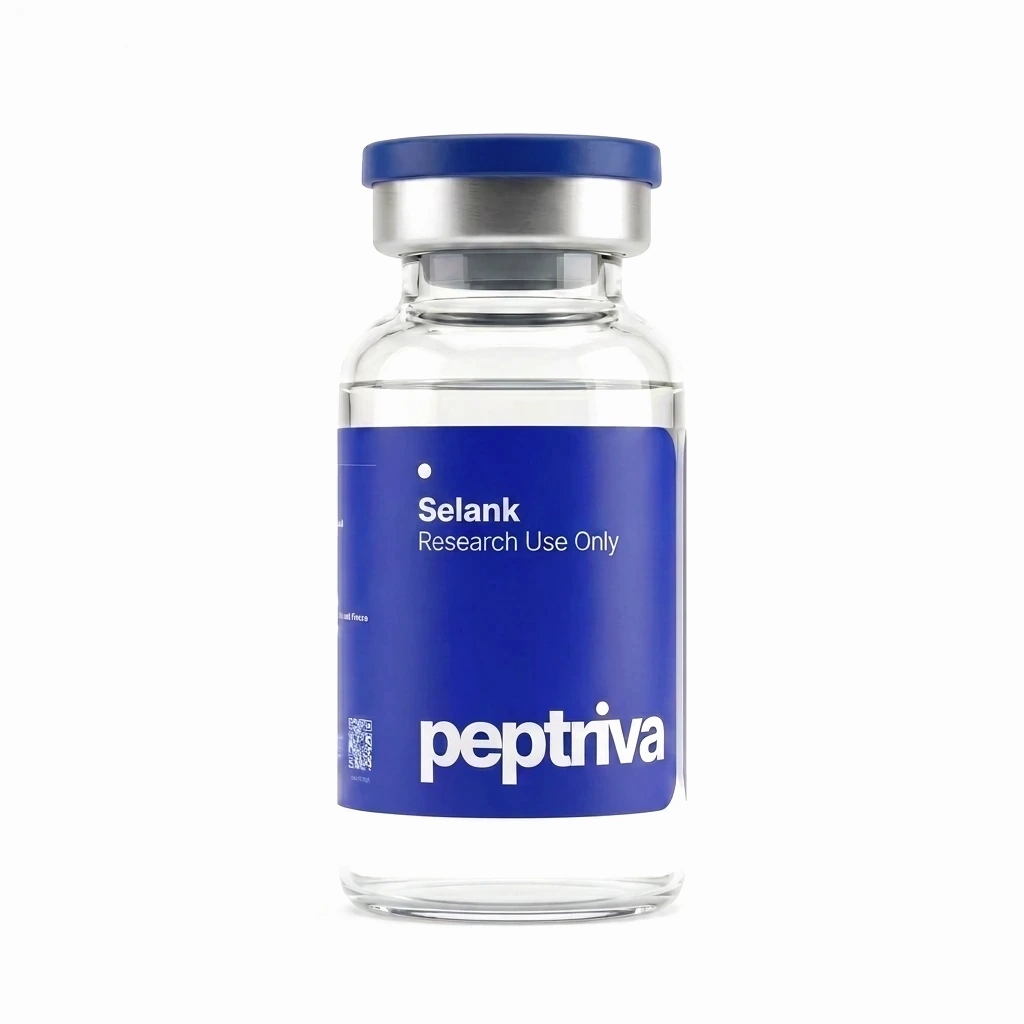
Selank
The same heptapeptide studied across the Russian clinical and preclinical work cited here, supplied as lyophilized powder with a certificate of analysis matched to the lot.
The one Western human study used the nose too
The most methodologically transparent human study of Selank is a brain-imaging experiment rather than a clinical trial. Panikratova and colleagues scanned 52 healthy adults in a placebo-controlled three-way design comparing Selank, Semax and placebo, with resting-state functional MRI taken before dosing and again at 5 and 20 minutes after intranasal administration.
The reported finding was a change in functional connectivity between the right amygdala and right temporal cortical regions — the network a candidate anxiolytic would be expected to touch — within 20 minutes of a nasal dose.
Selank produced detectable modulation of right amygdala connectivity with right temporal cortical regions within 20 minutes of intranasal administration in healthy adults.
Panikratova et al., Doklady Biological Sciences, 2020This is the best evidence that a nasal dose reaches the brain and does something measurable there, and it is worth taking seriously for exactly that. It is not evidence of symptom relief. The participants were healthy, the outcome was a connectivity biomarker rather than an anxiety score, and the observation window was twenty minutes.
The mechanism work, and what it rests on
The proposed mechanism is allosteric modulation rather than direct agonism. A radioligand binding study reported that Selank affects GABA binding as a positive allosteric modulator, and that its combined action with benzodiazepines is not additive — Selank could block the modulatory activity of diazepam and olanzapine, which the authors read as partly overlapping but distinct binding sites.
One of Selank anti-anxiety molecular mechanisms can be associated with subtype selective concentration-dependent allosteric modulation of GABA receptors.
Vyunova et al., Protein and Peptide Letters, 2018- Behavioral models. A single dose of 0.3 mg/kg reduced the total morphine-withdrawal score in rats by 39.6% and raised the tactile sensitivity threshold ninefold, against diazepam at 2 mg/kg as comparator.
- Combination behavior. Under unpredictable chronic mild stress, Selank plus diazepam was the most effective pairing in the elevated plus maze, while Selank alone was the most effective at reducing drug-induced anxiety in unstressed animals.
- Immune signaling. In a social-stress rat model, 100 µg/kg daily for 20 days reduced stress-driven elevations in IL-1β, IL-6, TNF-α and TGF-β1 and restored suppressed IL-4.
One structural caveat applies to all of it. These experiments are overwhelmingly from the institutes that developed the molecule, and several were given by injection rather than by nose — the morphine-withdrawal work was intraperitoneal. Mechanistic findings from an injected rat do not automatically describe what a nasal dose does in a person.
The measurement nobody has published
Here is the gap that route articles are supposed to name. For a compound whose defining feature is that it is given intranasally, there is no published figure for how much of a nasal dose of Selank reaches systemic circulation or the brain, in any species. No human pharmacokinetic study appears in the indexed literature.
What exists instead is indirect. The Panikratova imaging work shows a central effect after nasal dosing. Work on the same Russian family of peptides showed that intranasal administration of Semax altered BDNF and trkB messenger RNA in rat brain, which is a demonstration that this class can reach brain tissue by that route. And a serum study reported that Selank and Semax inhibit enkephalin-degrading enzymes, which is a proposed reason their effects outlast their measurable presence.
“It works intranasally” and “we know what fraction is absorbed intranasally” are different claims. For Selank the first has support and the second has none, which means no supplier can honestly convert a spray volume into a delivered dose.
What a Selank spray is worth, and to whom
Our read is that Selank sits in an awkward middle that suits neither the enthusiasts nor the dismissers. It has more behind it than most of the compounds in this library: an approved indication somewhere in the world, a coherent mechanism, a placebo-controlled imaging study, and a preclinical record spanning behavior, cytokines and stress physiology. It also has zero Western randomized controlled trials, in any indication.
That gap is structural rather than damning. The molecule is long out of patent protection in any practical sense, the intellectual property sits with Russian institutions, and the anxiety market is already served by cheap generics with large trial bases. Nobody has a commercial reason to spend nine figures proving it.
- Formulation is not interchangeable. The Russian safety experience is for a manufactured nasal solution, at short courses of days to weeks. Long-term use is essentially unstudied.
- Dose cannot be derived from the literature. The rodent doses cited above are per kilogram and by injection; the Russian product's dosing is a pharmaceutical instruction, not a published protocol you can scale.
- Interactions are plausible and uncharacterized. The GABA-modulation finding is precisely the reason to expect interaction with benzodiazepines and alcohol, and precisely what has not been studied outside rodents.
Selank
Research-use-only material, sold by the vial with batch documentation. Check the certificate of analysis against the batch you receive.
What to know now
- Intranasal is Selank's registered route, not a supplier format. Russia approved a nasal formulation for generalized anxiety disorder in 2009.
- The best Western human study is an imaging experiment in 52 healthy adults, showing amygdala connectivity changes within 20 minutes of a nasal dose.
- The clinical evidence behind the approval is Russian-language, small, and mostly open-label — the 2015 add-on study covered 70 patients in total.
- There are zero Western randomized controlled trials of Selank in any indication, and no published nasal bioavailability figure.
- The registered nasal solution and reconstituted research powder are not the same product, and the Russian safety data belongs to the first.
What we're watching
The single development that would change this page is a Western academic group registering a placebo-controlled trial, most plausibly in an inflammation-associated anxiety population where the cytokine findings would be testable as a mechanism rather than assumed. We are also watching for any pharmacokinetic work on intranasal delivery of this peptide class, since the absence of an absorption figure is the reason no dosing statement about a Selank spray can currently be evidence-based. Neither has appeared as of mid-2026.
Frequently asked questions
Is Selank nasal spray an approved drug?
In Russia, yes — it has been registered as a nasal formulation for generalized anxiety disorder since 2009. It is not approved by the FDA, the EMA, or any other major Western agency, and in the United States it is sold only as research-use material.
How much of a Selank nasal dose is absorbed?
Unpublished. No pharmacokinetic study reporting nasal bioavailability for Selank appears in the indexed literature, in humans or animals. A 2020 imaging study shows a central effect within 20 minutes of nasal dosing, which demonstrates that something reaches the brain without quantifying how much.
Is Selank the same as a benzodiazepine?
No. Binding work describes it as a positive allosteric modulator of GABA rather than a direct agonist, and it can block the modulatory effect of diazepam. Russian clinical reports describe anxiety reduction without the sedation and withdrawal that define benzodiazepines, but no Western head-to-head trial has tested that.
Why has no Western trial been run?
Commercial rather than scientific reasons. The intellectual property sits with Russian institutions, the molecule is effectively unprotectable, and generic SSRIs and benzodiazepines already occupy the indication — so no sponsor has an incentive to fund a Phase 3.
References
- Russian regulatory communications. (2009 onward.) Russian Ministry of Health approval of Selank as a nasal-drop formulation for generalized anxiety disorder. (Cited for regulatory context; primary trial documents are largely Russian-language and outside PubMed.) Russian Ministry of Health https://www.rosminzdrav.ru/
- Zozulya, A. A., Neznamov, G. G., Siuniakov, T. S., et al. (2008). Efficacy and possible mechanisms of action of a new peptide anxiolytic Selank in the therapy of generalized anxiety disorders and neurasthenia. Bulletin of Experimental Biology and Medicine, 146(6), 731–733. PubMed search PMID ?term=Zozulya+Selank+anxiolytic+generalized+anxiety+2008
- Medvedev, V. E., Tereshchenko, O. N., Kost, N. V., et al. (2015). Optimization of pharmacotherapy of anxiety-phobic disorders with the use of Selank. Zhurnal Nevrologii i Psikhiatrii imeni S.S. Korsakova, 115(7), 33–40. https://doi.org/10.17116/jnevro20151156133-40
- Panikratova, Y. R., Lebedeva, I. S., Sokolov, O. Y., et al. (2020). Functional connectomic approach to studying Selank and Semax effects. Doklady Biological Sciences, 490(1), 9–11. https://doi.org/10.1134/S001249662001007X
- Vyunova, T. V., Andreeva, L., Shevchenko, K., & Myasoedov, N. (2018). Peptide-based anxiolytics: The molecular aspects of heptapeptide Selank biological activity. Protein and Peptide Letters, 25(10), 914-923. https://doi.org/10.2174/0929866525666180925144642
- Kasian, A., Kolomin, T., Andreeva, L., Bondarenko, E., Myasoedov, N., Slominsky, P., & Shadrina, M. (2017). Peptide Selank enhances the effect of diazepam in reducing anxiety in unpredictable chronic mild stress conditions in rats. Behavioural Neurology, 2017, 5091027. https://doi.org/10.1155/2017/5091027
- Konstantinopolsky, M. A., Chernyakova, I. V., & Kolik, L. G. (2022). Selank, a peptide analog of tuftsin, attenuates aversive signs of morphine withdrawal in rats. Bulletin of Experimental Biology and Medicine, 173(6), 730–733. https://doi.org/10.1007/s10517-022-05624-x
- Yasenyavskaya, A. L., Samotrueva, M. A., Tsibizova, A. A., et al. (2021). The influence of Selank on the level of cytokines under the conditions of "social" stress. Current Reviews in Clinical and Experimental Pharmacology, 16(2), 162–167. https://doi.org/10.2174/1574884715666200704152810
- Mukhina, A. Y., Mishina, E. S., Bobyntsev, I. I., et al. (2020). Morphological changes in the large intestine of rats subjected to chronic restraint stress and treated with Selank. Bulletin of Experimental Biology and Medicine, 169(2), 281–285. https://doi.org/10.1007/s10517-020-04868-9
- Kost, N. V., Sokolov, O. Y., Kolyasnikova, K. N., et al. (2016). Semax and selank inhibit the enkephalin-degrading enzymes from human serum. Russian Journal of Bioorganic Chemistry, 42(4), 425–431. https://doi.org/10.1023/a:1011373002885
- Inozemtseva, L. S., Karpenko, E. A., Dolotov, O. V., et al. (2008). Intranasal administration of the peptide Semax affects rat brain BDNF and trkB mRNA levels. Doklady Biological Sciences, 421, 241–243. PubMed search PMID ?term=Inozemtseva+Semax+BDNF+intranasal+2008
- Plotnikov, A. N., Lokhonina, A. V., Korabel'nikova, E. A., et al. (2015). Influence of Selank on parameters of the psychophysiological status and the autonomic nervous system. Bulletin of Experimental Biology and Medicine, 159(2), 169–172. PubMed search PMID ?term=Plotnikov+Selank+psychophysiological+autonomic+2015