
Every list of DSIP benefits traces back to four papers. One used rabbits in 1977. One used alcohol-withdrawal patients in 1988. Two used rats in 2021. The rest of the list has nothing under it.
The short answer. Every marketed DSIP benefit traces to a different species and a different paper.
- The sleep claim comes from a 1977 rabbit EEG study that no human trial has confirmed.
- The cortisol claim rests on one small 1988 report in alcohol-withdrawal patients.
- The strongest modern work is rat stroke and heart-reperfusion research, not sleep.
DSIP is a 9-amino-acid peptide found in 1977. Its name came from delta waves in rabbit EEG. No human trial has confirmed a sleep effect. The cortisol claim rests on one small 1988 report. The strongest modern data is rat stroke work. In one pilot, badly timed dosing killed 100% of animals.
What are the claimed DSIP benefits, and where does each one come from?
Sellers list four or five benefits. Each one belongs to a different paper, in a different species, measuring a different thing. Sorting them apart is most of the work.
| Marketed claim | Source it traces to | What was actually measured |
|---|---|---|
| Deep sleep, more delta waves | Schoenenberger & Monnier, PNAS, 1977 | EEG delta activity in rabbits after transfusion of brain blood |
| Lower cortisol, stress relief | Iyer & McCann, 1988 | Cortisol in a small group of alcohol-withdrawal patients |
| Neuroprotection | Tukhovskaya et al., Molecules, 2021 | Motor recovery in Sprague-Dawley rats after focal stroke |
| Heart protection | Tukhovskaya et al., Biomedicines, 2021 | Infarct size in rats and mice dosed during reperfusion |
| Insomnia reversal | Mu et al., Frontiers in Pharmacology, 2024 | A DSIP fusion peptide in PCPA-treated mice |
| Pain relief, growth hormone, anti-aging | No study on this page’s reference list | Nothing we can point you to |
Read down the middle column. Rabbits, rats, mice, and one human group of people in alcohol withdrawal. Controlled trials in healthy sleepers number zero.
Does DSIP actually improve sleep?
No human trial has shown that. The sleep claim is a name, not a result.
In 1977, Schoenenberger and Monnier pulled a 9-amino-acid peptide from the brain blood of rabbits during electrically induced sleep. They named it after the EEG band it seemed to shift, the slow delta rhythm between 0.5 and 4 Hz.
Characterization of a delta-electroencephalogram (δ-sleep)-inducing peptide.
Schoenenberger & Monnier, PNAS, 1977 — the paper title is the whole claimThat title has carried the compound for 48 years. What it did not carry is a replication in people. Inoué’s 2020 review of sleep substances still describes the physiology as unsettled and the receptor as unidentified.
The newest sleep-adjacent work is Mu and colleagues, 2024, in Frontiers in Pharmacology. They used yeast to secrete a DSIP fusion peptide, checked that it crossed the blood-brain barrier, and tested it in mice made insomniac with PCPA. They reported movement in 4 neurotransmitter systems and a blood level around 75 ng/mL.
- It is mice, not people with insomnia.
- It is a fusion peptide, engineered for delivery, not the plain 9-residue sequence in a vial.
- The model is chemical. PCPA depletes serotonin to force insomnia. That is not ordinary poor sleep.
We take the delta-wave story apart in full in the DSIP delta wave mechanism page.
Does DSIP lower cortisol?
One human report says something like that. It is from 1988, and its subjects were in alcohol withdrawal.
Iyer and McCann described cortisol suppression in that group. It is the foundational human data point cited across the DSIP stress literature, and it is also nearly the only one. One small report, in patients whose HPA axis was already disturbed by withdrawal, is not evidence about a healthy person under work stress.
The gap here is direction, not just size. Alcohol withdrawal drives cortisol up sharply. A peptide that blunts that says nothing about baseline cortisol in someone who is not withdrawing.
The modern Russian preclinical program does not target stress at all. It targets stroke and heart-attack injury. Our cortisol research page lays out what the 1988 report did and did not measure.
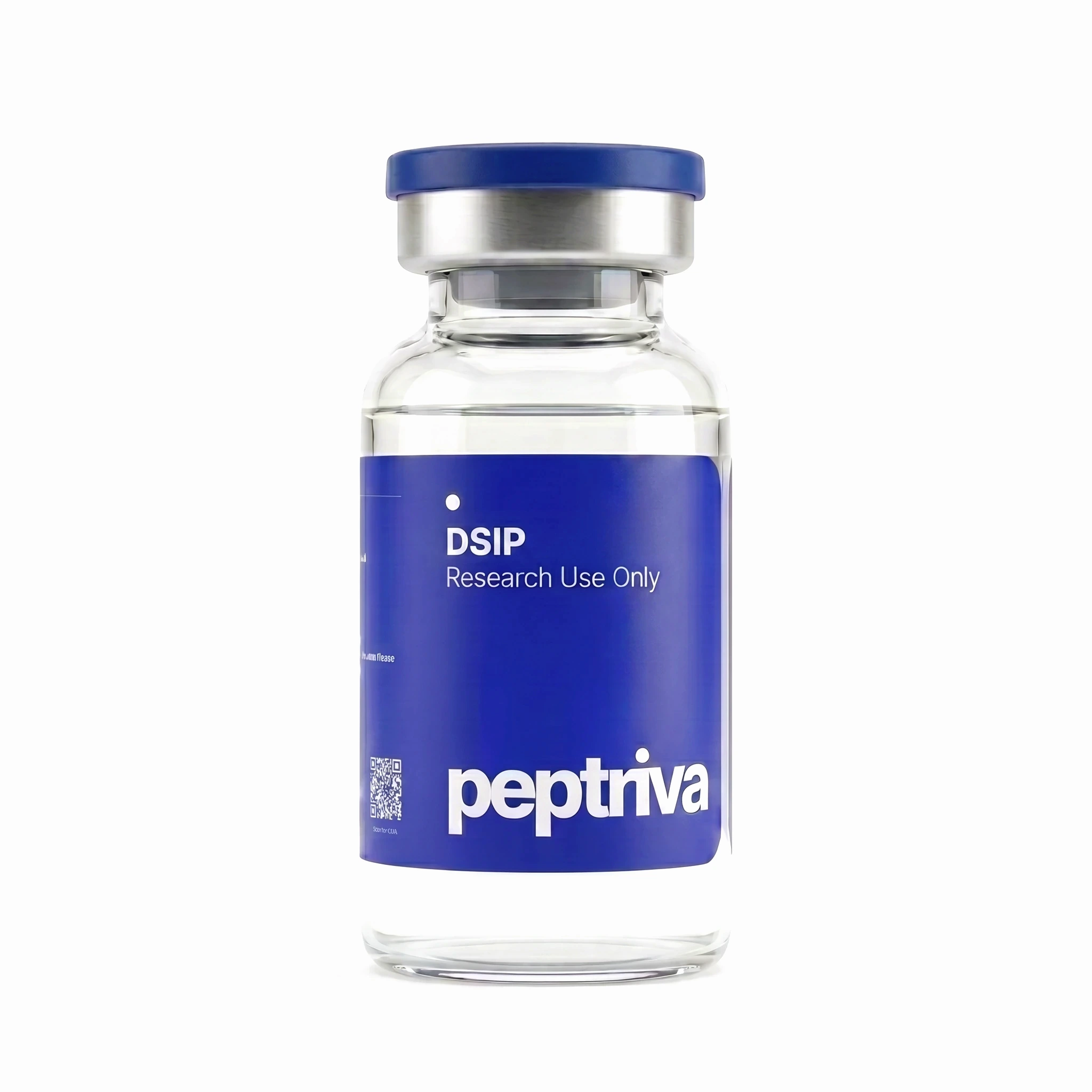
DSIP
The compound discussed here, supplied as a research compound with a certificate of analysis matched to the lot.
The strongest DSIP data is about stroke, not sleep
If you rank the DSIP literature by study quality, sleep is not at the top. Two 2021 papers from Tukhovskaya and colleagues are.
Delta Sleep-Inducing Peptide Recovers Motor Function in SD Rats after Focal Stroke.
Tukhovskaya et al., Molecules, 2021That study administered 120 mcg/kg for 7 days to rats after a focal stroke and scored motor recovery. The companion paper in Biomedicines tested a DSIP-like peptide called KND and reported smaller brain and heart infarcts when it was given during reperfusion.
DSIP-Like KND Peptide Reduces Brain Infarction in C57Bl/6 and Reduces Myocardial Infarction in SD Rats When Administered during Reperfusion.
Tukhovskaya et al., Biomedicines, 2021Two things about that second title matter. The peptide is KND, a DSIP analog, not DSIP itself. And the timing word is during reperfusion, meaning a hospital window that has nothing to do with a vial at home.
There is a harder detail marketing leaves out. Pilot work dosed animals during the stroke rather than after it, and 100% of those animals died. Timing was not a detail in this research. It was the difference between benefit and total mortality.
The full development history is in the DSIP complete guide.
Why the mechanism claims stay empty
Nearly 50 years after the isolation paper, no DSIP receptor has been identified. The search has come back empty.
That is unusual for a peptide sold on a mechanism. Without a receptor, nobody can say which cells respond, how much reaches them, or how long the signal lasts. Inoué’s 2020 chapter treats the question as open, not settled.
- No receptor means no dose-response curve anyone can defend.
- No human pharmacokinetics for the plain 9-residue peptide by the route hobbyists use.
- No Western randomized trial of DSIP for sleep, stress, or recovery.
- No approved product. DSIP is a research chemical, not a medicine, whatever a vendor page implies.
What you can actually verify before buying
You cannot verify a benefit that was never measured in people. You can verify the vial.
Ask for a batch-specific certificate of analysis with mass spectrometry and purity by HPLC. Our COA guide shows what a real one looks like and which parts get faked. Short peptides also degrade with heat, so storage temperature matters more than most buyers assume.
The legal position is its own question. Our page on peptide legality covers research-use labeling in the US. And if you are comparing suppliers on documents rather than marketing, our sourcing comparison sets out the criteria we use.
DSIP
Research-use-only material, sold by the vial with batch documentation. Check the certificate of analysis against the batch you receive.
What to know now
- Every marketed DSIP benefit traces to a different species and a different paper.
- The sleep claim comes from a 1977 rabbit EEG study that no human trial has confirmed.
- The cortisol claim rests on one small 1988 report in alcohol-withdrawal patients.
- The strongest modern work is rat stroke and heart-reperfusion research, not sleep.
- Pilot animal work with the wrong dosing window saw 100% mortality.
- No DSIP receptor has been identified in nearly 50 years.
What we're watching
The thing that would change this page is a registered, placebo-controlled human sleep trial with polysomnography rather than self-report. None is running that we can point you to. Until then, the delta-wave claim stays a 1977 rabbit result with a name attached.
Frequently asked questions
Does DSIP actually help you sleep?
No human trial has confirmed that. The name comes from a 1977 rabbit study by Schoenenberger and Monnier, which tracked EEG delta activity between 0.5 and 4 Hz. A 2024 mouse study used an engineered DSIP fusion peptide in a chemically induced insomnia model, not ordinary poor sleep in people.
What is the best human evidence for DSIP?
One small 1988 report from Iyer and McCann on cortisol in alcohol-withdrawal patients. That is the foundational human data point cited across the DSIP literature. There is no Western randomized controlled trial.
Is DSIP FDA approved?
No. DSIP is sold as a research chemical. It is not an approved drug for sleep, stress, or anything else in the United States, and no approval application is something we can point you to.
Why does DSIP research focus on stroke?
Because that is where the modern funding went. Two 2021 papers from Tukhovskaya and colleagues tested DSIP and a DSIP-like analog called KND in rats and mice, measuring infarct size and motor recovery. Those are the most rigorous studies in the file, and they are animal studies.
Are there known risks with DSIP?
The human safety record is close to nonexistent, which is itself the risk. One preclinical detail stands out: in pilot work where animals were dosed during the stroke rather than after it, 100% of them died. Timing changed the outcome completely in that model.
Does DSIP raise growth hormone or relieve pain?
Those claims appear on vendor pages, but none of the studies we reviewed for this article measured either endpoint. We have nothing to cite for them.
References
- Schoenenberger, G. A., & Monnier, M. (1977). Characterization of a delta-electroencephalogram (-sleep)-inducing peptide. Proceedings of the National Academy of Sciences USA, 74(3), 1282–1286. (Original DSIP isolation paper; cited here for historical context.) https://doi.org/10.1073/pnas.74.3.1282
- Iyer, K. S., & McCann, S. M. (1988). Delta sleep inducing peptide (DSIP) suppression of cortisol in alcohol-withdrawal patients. Annals of the New York Academy of Sciences, 525, 530–532. [Foundational early human data point cited across the DSIP HPA-axis literature.] https://doi.org/10.1159/isbn.978-3-8055-8782-2
- Tukhovskaya, E. A., Ismailova, A. M., Shaykhutdinova, E. R., et al. (2021). Delta Sleep-Inducing Peptide Recovers Motor Function in SD Rats after Focal Stroke. Molecules, 26(17), 5173. https://doi.org/10.3390/molecules26175173
- Tukhovskaya, E. A., Shaykhutdinova, E. R., Ismailova, A. M., et al. (2021). DSIP-Like KND Peptide Reduces Brain Infarction in C57Bl/6 and Reduces Myocardial Infarction in SD Rats When Administered during Reperfusion. Biomedicines, 9(4), 407. https://doi.org/10.3390/biomedicines9040407
- Mu, X., Qu, L., Yin, L., Wang, L., Liu, X., & Liu, D. (2024). Pichia pastoris secreted peptides crossing the blood-brain barrier and DSIP fusion peptide efficacy in PCPA-induced insomnia mouse models. Frontiers in Pharmacology, 15, 1439536. https://doi.org/10.3389/fphar.2024.1439536
- Inoué, S. (2020). Delta-sleep-inducing peptide and its derivatives. In Biology of Sleep Substances (chapter 3). CRC Press. (Modern review of DSIP physiology and the unresolved receptor question; readers should treat the 2020–2026 PubMed-indexed literature, including Tukhovskaya 2021 and Mu 2024 above, as the relevant modern evidence base for the mechanism questions discussed here.) https://doi.org/10.1201/9781003068228-3