
Almost every CJC-1295 benefits list mixes two different things. One item was measured in this molecule: growth hormone rose 2- to 10-fold. The rest were measured in other drugs, or in nothing at all.
The short answer. The one measured CJC-1295 benefit is a hormone rise: GH up 2- to 10-fold, IGF-1 up 1.5- to 3-fold.
- Those figures come from two 2006 dose-ranging trials lasting 28 and 49 days, which measured blood and nothing else.
- Visceral fat and liver fat claims trace to tesamorelin, a different 44-amino-acid GHRH analog with an actual approval and HIV trial program.
- Muscle, recovery and anti-aging claims trace to class reviews and animal work, not to any CJC-1295 trial.
CJC-1295 has one measured benefit. It raises growth hormone in the blood. Two 2006 trials showed GH up 2- to 10-fold. IGF-1 rose 1.5- to 3-fold. Nobody measured fat, muscle or sleep. Zero randomized trials have tested those claims.
What CJC-1295 was actually shown to do
CJC-1295 is a 29-amino-acid analog of growth hormone releasing hormone. It binds the GHRH receptor on the pituitary and tells it to release growth hormone. That is the mechanism, and it is not in dispute.
The human record is two placebo-controlled dose-ranging trials from 2006, running 28 and 49 days. Healthy adults received single subcutaneous doses in the range of 30 to 60 µg/kg. Growth hormone rose 2- to 10-fold. IGF-1 rose 1.5- to 3-fold.
That is the benefit. It is a blood draw. Nobody in those trials was weighed, scanned, photographed or asked how they slept.
The published data measured blood, not bodies. Nobody was weighed, scanned or photographed.
Where to Buy Peptides, CJC-1295 before and afterThe gap between a hormone level and a visible result is the whole subject of this page. We take the two trials apart in CJC-1295 before and after, and the receptor biology in the GHRH receptor mechanism page.
Which benefit belongs to which molecule
Here is the same list you see on a vendor page, with a column added for where each claim was actually generated.
| Claimed benefit | Where the claim comes from | CJC-1295 evidence |
|---|---|---|
| Higher growth hormone | CJC-1295 itself | Two 2006 trials, 28 and 49 days |
| Higher IGF-1 | CJC-1295 itself | Same two trials, 1.5- to 3-fold |
| Visceral fat reduction | Tesamorelin, a different GHRH analog | No CJC-1295 trial |
| Liver fat improvement | Tesamorelin, HIV cohorts | No CJC-1295 trial |
| Lean mass gain | Growth hormone secretagogue class reviews | No CJC-1295 trial |
| Deeper sleep | Growth hormone class lore | No CJC-1295 trial |
| Injury and tendon repair | Sports medicine reviews, mostly preclinical | No CJC-1295 trial |
| Appetite and weight in illness | Ipamorelin, in ferrets | No CJC-1295 trial |
| Anti-aging | The GH decline narrative | No CJC-1295 trial |
Only the top two rows were measured in CJC-1295. Every other row was borrowed from a different compound, a different species, or a general idea about growth hormone.
The fat-loss claim belongs to tesamorelin
This is the substitution that does the most work in CJC-1295 marketing. Tesamorelin is also a GHRH analog. It is a longer molecule at 44 amino acids, and unlike CJC-1295 it went through a real clinical program and carries an FDA approval for HIV-associated lipodystrophy.
Tesamorelin has the kind of record CJC-1295 does not:
- Russo and colleagues, in AIDS in 2024, tested efficacy and safety in people with HIV taking integrase inhibitors.
- Fourman and colleagues, in JCI Insight in 2020, looked at hepatic transcriptomic signatures in HIV-associated fatty liver disease.
- Ellis and colleagues, in the Journal of Infectious Diseases in 2025, tested neurocognitive endpoints in people with HIV and abdominal obesity.
Those are trials with named investigators, named populations and named endpoints. None of them administered CJC-1295. A benefit claim that traces to this body of work is a claim about tesamorelin in people with HIV, not about a research vial of a 29-residue analog in a healthy adult. The two molecules are set side by side in CJC-1295 vs tesamorelin.
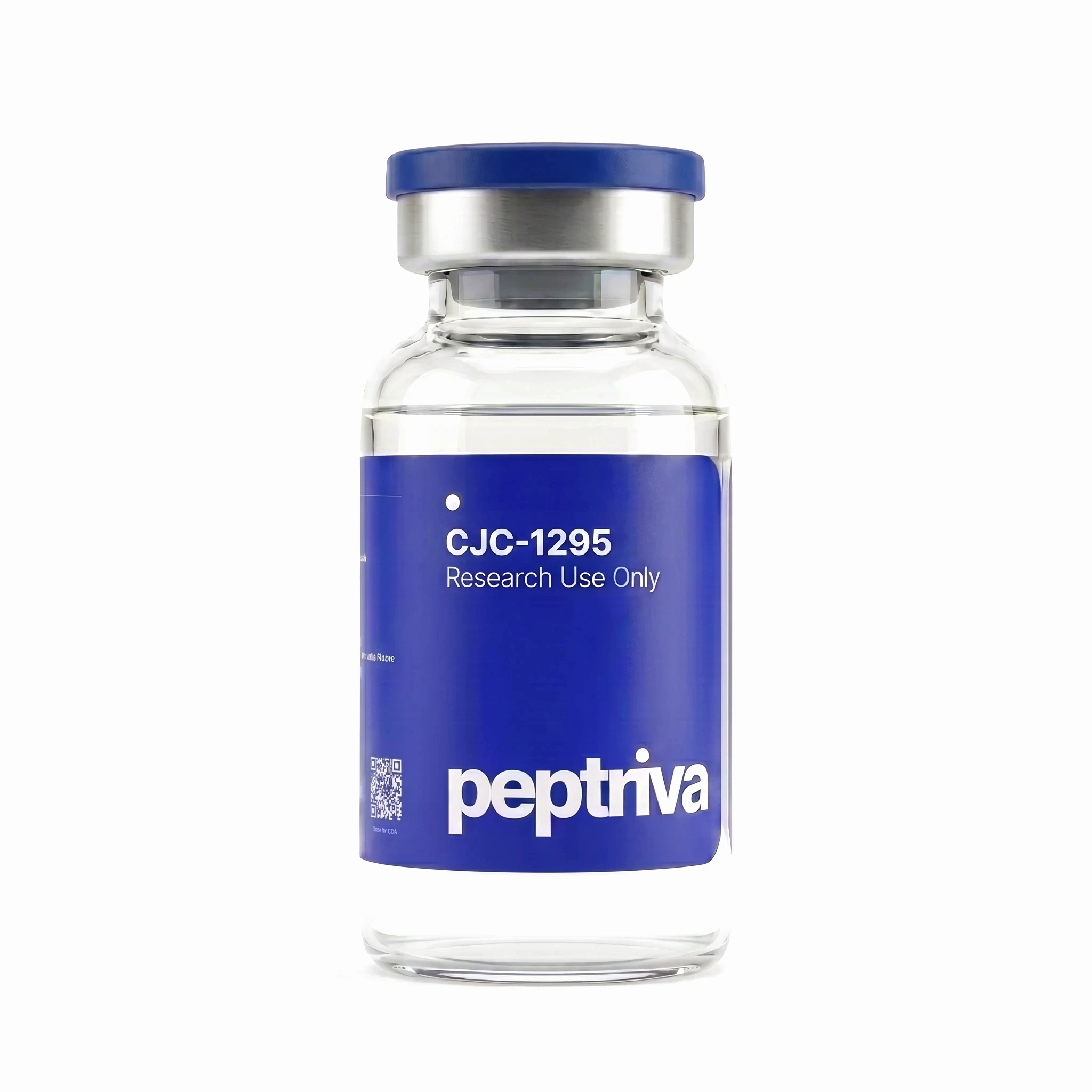
CJC-1295
The compound discussed here, supplied as a research compound with a certificate of analysis matched to the lot.
The muscle and recovery claims belong to the class, not the compound
Sinha and colleagues, writing in Translational Andrology and Urology in 2020, reviewed growth hormone secretagogues for body composition in hypogonadal men. That review is about a class of drugs. It is not a trial of CJC-1295 in healthy people who want a different physique.
The 2026 sports medicine literature is blunter about where these compounds sit. Mendias and Awan, in Sports Medicine, published a review whose title separates approved from unapproved peptide therapies for musculoskeletal injury and athletic performance. Mayfield and colleagues, in the American Journal of Sports Medicine, wrote a primer for physicians on injectable peptide therapy. Rahman, Lee and Seeds, in JAAOS Global, covered applications and challenges in orthopaedics.
Read as a group, those papers describe a field of interest without a controlled human result for this molecule. Coutinho and colleagues, in the Journal of Sports Medicine and Physical Fitness, framed the same compounds as a doping question in recreational and professional sport.
The blend partner has the same problem in a different shape. The weight and appetite data people attach to ipamorelin includes Lu and colleagues, 2024, showing that anamorelin and ipamorelin blunted cisplatin-induced weight loss in ferrets, and Mohammadi and colleagues, 2020, on ghrelin mimetics and nociception in animals. Those are real findings in animals given a sick-animal problem. They are not a body composition benefit in a healthy person. See CJC-1295 vs ipamorelin.
Why the recent papers are about catching it, not testing it
If CJC-1295 were producing benefits worth measuring, the recent literature would be measuring them. It is not. The bulk of published work since 2020 is analytical chemistry for anti-doping labs.
Most 2020–2026 papers cover doping detection, not efficacy. Zero randomized trials have tested it for muscle, fat or aging.
Where to Buy Peptides, CJC-1295 complete guideFour major detection-methods papers sit in this reference list alone. Memdouh and colleagues, in Drug Testing and Analysis in 2021, reviewed advances in detecting synthetic GHRH analogs. Coppieters and colleagues built an antibody-free ultrafiltration assay for urine in 2022. Cristea and colleagues published a cation-exchange UHPLC-MS/MS method in 2023. Thomas, Walpurgis and Thevis covered peptide analytes in doping control urine in 2024.
That is a decade of scientists getting better at finding CJC-1295 in urine, and almost nobody testing whether it does anything. WADA lists it under S2.
The gerontology side is thinner than it looks too. Mavrych and colleagues, in Frontiers in Aging in 2026, surveyed therapeutic peptides for healthy aging as a field. A field survey is not a result for one molecule.
What can be checked instead
You cannot verify a benefit that was never measured. You can verify the vial.
- Identity and purity. Ask for a third-party certificate of analysis with a batch number that matches the label.
- Which form you have. The no-DAC form clears in about 30 minutes. The DAC form binds albumin and lasts 6 to 8 days. Sellers often use one name for both.
- Handling. Storage temperature and reconstitution decide what is left in the vial after week one.
- Legal status. These are research compounds, not approved drugs. The legality page covers the framing.
The published safety record is the same two 2006 trials, which reported no serious adverse reactions and best tolerance at the lower end of the tested range. That record is short. CJC-1295 side effects explains what it does and does not cover.
CJC-1295
Research-use-only material, sold by the vial with batch documentation. Check the certificate of analysis against the batch you receive.
What to know now
- The one measured CJC-1295 benefit is a hormone rise: GH up 2- to 10-fold, IGF-1 up 1.5- to 3-fold.
- Those figures come from two 2006 dose-ranging trials lasting 28 and 49 days, which measured blood and nothing else.
- Visceral fat and liver fat claims trace to tesamorelin, a different 44-amino-acid GHRH analog with an actual approval and HIV trial program.
- Muscle, recovery and anti-aging claims trace to class reviews and animal work, not to any CJC-1295 trial.
- Most published work on CJC-1295 since 2020 is anti-doping detection chemistry. WADA lists it under S2.
What we're watching
When a fat-loss photo is attached to CJC-1295, the underlying trial is almost always tesamorelin's. Ask which molecule was in the syringe, and in which population.
Frequently asked questions
What are the proven benefits of CJC-1295?
One: it raises growth hormone and IGF-1 in the blood. Two placebo-controlled dose-ranging trials from 2006, running 28 and 49 days, reported GH up 2- to 10-fold and IGF-1 up 1.5- to 3-fold. No published trial has measured whether that translates into fat loss, muscle gain, better sleep or faster healing.
Does CJC-1295 burn fat?
No CJC-1295 trial has measured fat. The fat-loss evidence in this drug class belongs to tesamorelin, a longer GHRH analog studied in people with HIV-associated lipodystrophy by groups including Russo and colleagues in 2024 and Fourman and colleagues in 2020. Tesamorelin is a different molecule and a different population.
How long does it take CJC-1295 to work?
That question assumes an outcome that has not been measured. What was measured is pharmacokinetics: the no-DAC form clears in about 30 minutes, and the DAC form binds albumin and persists 6 to 8 days. Hormone levels moved within the 28- and 49-day trial windows. Body outcomes were never recorded, so there is no timeline for them.
Is CJC-1295 better than ipamorelin?
They act on different receptors and neither has a controlled trial in healthy adults for body composition. The ipamorelin data people cite includes Lu and colleagues, 2024, in ferrets given cisplatin. Our CJC-1295 vs ipamorelin comparison sets out what each one has behind it.
Why do so many recent papers mention CJC-1295?
Because anti-doping labs need to detect it. Memdouh 2021, Coppieters 2022, Cristea 2023 and Thomas 2024 are all analytical methods work on GHRH analogs in urine. They confirm that people are using the compound. They say nothing about whether it helps.
Is CJC-1295 approved by the FDA?
No. It is sold as a research compound. The FDA approval attached to tesamorelin, a different GHRH analog, does not transfer to a CJC-1295 vial in any way.
References
- Mendias, C. L., & Awan, T. M. (2026). Safety and efficacy of approved and unapproved peptide therapies for musculoskeletal injuries and athletic performance. Sports Medicine. https://doi.org/10.1007/s40279-026-02437-0
- Mavrych, V., Shypilova, I., & Bolgova, O. (2026). Therapeutic peptides in gerontology: Mechanisms and applications for healthy aging. Frontiers in Aging, 7, 1790247. https://doi.org/10.3389/fragi.2026.1790247
- Coutinho, L. F. D., De Oliveira Neves, L. F., & Camilo, R. P. (2026). A new era of doping? Use of peptide and peptide-analog drugs in recreational and professional sport and bodybuilding. Journal of Sports Medicine and Physical Fitness. https://doi.org/10.23736/S0022-4707.26.17773-1
- Mayfield, C. K., Bolia, I. K., Feingold, C. L., et al. (2026). Injectable peptide therapy: A primer for orthopaedic and sports medicine physicians. American Journal of Sports Medicine, 54(1), 223–229. https://doi.org/10.1177/03635465251357593
- Sinha, D. K., Balasubramanian, A., Tatem, A. J., et al. (2020). Beyond the androgen receptor: the role of growth hormone secretagogues in the modern management of body composition in hypogonadal males. Translational Andrology and Urology, 9(Suppl 2), S149–S159. https://doi.org/10.21037/tau.2019.11.30
- Memdouh, S., Gavrilović, I., Ng, K., Cowan, D., & Abbate, V. (2021). Advances in the detection of growth hormone releasing hormone synthetic analogs. Drug Testing and Analysis, 13(11–12), 1871–1887. https://doi.org/10.1002/dta.3183
- Coppieters, G., Deventer, K., Polet, M., Van Eenoo, P., & Judák, P. (2022). An antibody-free, ultrafiltration-based assay for the detection of growth hormone-releasing hormones in urine. Journal of Pharmaceutical and Biomedical Analysis, 214, 114726. https://doi.org/10.1016/j.jpba.2022.114726
- Cristea, C. D., Radu, M., Toboc, A., Stan, C., & David, V. (2023). Cationic exchange SPE combined with triple quadrupole UHPLC-MS/MS for detection of GHRHs in urine samples. Analytical Biochemistry, 682, 115336. https://doi.org/10.1016/j.ab.2023.115336
- Thomas, A., Walpurgis, K., & Thevis, M. (2024). Chromatographic-mass spectrometric analysis of peptidic analytes in doping control urine samples. Journal of Mass Spectrometry, 59(1), e4996. https://doi.org/10.1002/jms.4996
- Rahman, O. F., Lee, S. J., & Seeds, W. A. (2026). Therapeutic peptides in orthopaedics: Applications, challenges, and future directions. Journal of the American Academy of Orthopaedic Surgeons Global Research & Reviews, 10(1). https://doi.org/10.5435/JAAOSGlobal-D-25-00236
- Mohammadi, E. N., Louwies, T., Pietra, C., Northrup, S. R., & Greenwood-Van Meerveld, B. (2020). Attenuation of visceral and somatic nociception by ghrelin mimetics. Journal of Experimental Pharmacology, 12, 267–274. https://doi.org/10.2147/JEP.S249747
- Lu, Z., Ngan, M. P., Liu, J. Y. H., et al. (2024). The growth hormone secretagogue receptor 1a agonists, anamorelin and ipamorelin, inhibit cisplatin-induced weight loss in ferrets. Physiology & Behavior, 284, 114644. https://doi.org/10.1016/j.physbeh.2024.114644
- Russo, S. C., Ockene, M. W., Arpante, A. K., et al. (2024). Efficacy and safety of tesamorelin in people with HIV on integrase inhibitors. AIDS, 38(12), 1758–1764. https://doi.org/10.1097/QAD.0000000000003965
- Fourman, L. T., Billingsley, J. M., Agyapong, G., et al. (2020). Effects of tesamorelin on hepatic transcriptomic signatures in HIV-associated NAFLD. JCI Insight, 5(16). https://doi.org/10.1172/jci.insight.140134